Research / Calabi–Yau transitions
When can a singular space become smooth?
Every singularity has a local story. A compact space has a global one, and the two need not agree. Six papers work out when the local possibilities can coexist, and how mirror symmetry exchanges the relations that decide it.
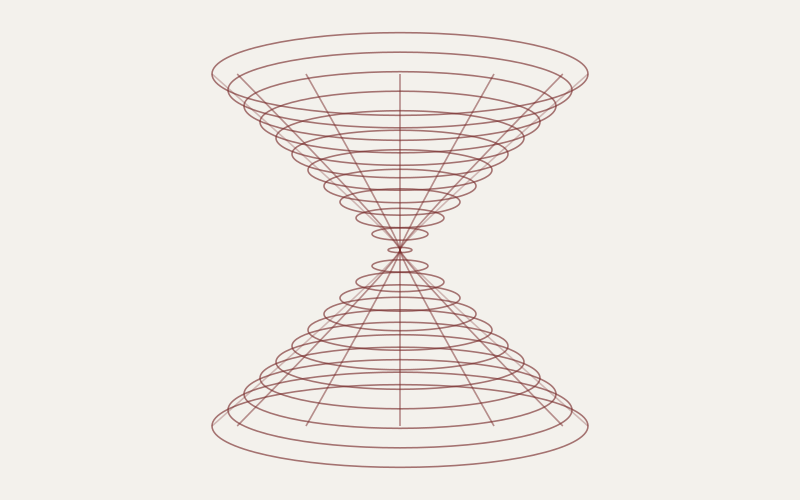
A route through the subject
Calabi–Yau transitions
01
Local possibilities
Which singularities admit smoothings, and which already obstruct the whole space?
02
Global compatibility
What relations must the local smoothing parameters satisfy?
03
Mirror geometry
How do relations among exceptional curves appear as relations among mirror vanishing spheres?
Start by watching the transition
Then continue to the manuscripts below. The illustrations offer intuition; each paper states the mathematical or empirical scope of its argument.
A manuscript to begin with: Non-smoothable Calabi–Yau threefolds from reflexive polytopes.
Scope of the work
Paper 5 concerns nodes and specified del Pezzo and quadric cone points. Paper 6 treats specified Batyrev families and the connected nodal components meeting its construction near the maximally degenerate limit. These are precise classes of spaces, not claims about every Calabi–Yau threefold.
Smoothability of Calabi–Yau threefolds
From local singularities to global relations.
A singularity may admit a smoothing on its own while the compact threefold admits none. The six papers follow this discrepancy from explicit toric examples to a global smoothing criterion, then ask how mirror symmetry transforms the relations that govern a transition.
The route through examples
Begin with Paper I: local obstructions, which constructs compact nonsmoothable threefolds from reflexive polytopes. Paper II: ambient constructions asks when deforming the toric pair produces a smoothing. Paper III: isolated mirror pairs classifies Batyrev mirror pairs with at most isolated singularities and supplies examples where local analysis leaves a global question unanswered.
The route to the criterion
Start with Paper IV: the vanishing-cycle obstruction if the central question is why locally possible smoothings fail to coexist. Its period argument applies to smoothing arcs of arbitrary contact order. Continue to Paper V: the mixed smoothing criterion: for the stated nodes and cone germs, a global homological relation must avoid every local discriminant. This gives necessity, sufficiency and integrability under the specified hypotheses.
Read I → II → III → IV → V → VI for the full development, or IV → V for the smoothing criterion. The Conifold Lab gives a visual introduction. The physics companions below begin with what the compact geometry permits.
6 papers · Suggested reading sequence
The manuscripts.
- 01
Non-smoothable Calabi–Yau threefolds from reflexive polytopes
Local obstructions: construct nonsmoothable examples from reflexive polytopes.
Preprint · 2026 · Abstract, PDF & citation ↗
Read the abstract
We construct projective Calabi–Yau threefolds with isolated Gorenstein canonical singularities that admit no smoothing, as anticanonical hypersurfaces in Gorenstein Fano toric fourfolds. One example has a unique singularity, the anticanonical cone over the first Hirzebruch surface. Another has a unique singularity whose reduced miniversal base is a smooth curve but whose deformations are all singular. The construction combines Altmann’s deformation theory with the smoothing criterion of Corti–Filip–Petracci: a two-dimensional face of the ambient fan polytope with primitive edges obstructs smoothing if it has no Minkowski decomposition into unit segments and unimodular triangles. We also classify the 217 isolated Gorenstein toric threefold singularities whose polygon edge vectors have coordinates in in some lattice basis, recording their deformation types and smoothing components. A scan of the Kreuzer–Skarke classification finds this obstruction in of its polytopes (approximately ), whose generic anticanonical hypersurfaces therefore admit no smoothing.
- 02
Deformations of toric pairs and the smoothing of Batyrev Calabi–Yau threefolds
Ambient constructions: identify when toric deformations produce smoothings.
Preprint · 2026 · Abstract, PDF & citation ↗
Read the abstract
Let be a reflexive four-polytope with primitive edges. We construct deformations of the toric fourfold defined by its face fan that smooth the singularities of a generic anticanonical Calabi–Yau hypersurface over a chosen two-dimensional face. The construction applies when the face cone is smoothable and the dual edge has an interior lattice point; its equations are trinomials in Cox coordinates. It gives a smoothing of the hypersurface when this is the only face whose cone is singular. If every singular face satisfies these conditions, simultaneous smoothing follows in the nodal case and, in general, under irreducibility of the semiuniversal deformation space. A seven-vertex example with one ordinary double point and no smoothing shows that the dual-edge condition is sharp. A scan of the Kreuzer–Skarke classification shows that the facewise criterion accounts for 3,774 of the 30,241 smoothings in the Batyrev–Kreuzer census; the other 26,467 require relations among exceptional curve classes from different faces.
- 03
Doubly isolated Batyrev mirror pairs and non-smoothable Calabi–Yau threefolds
A classification: study mirror pairs whose singularities are isolated on both sides.
Preprint · 2026 · Abstract, PDF & citation ↗
Read the abstract
We classify reflexive four-polytopes for which the generic anticanonical hypersurfaces associated with the face fans of the polytope and its polar both have at most isolated singularities. There are exactly 590 such polytopes up to lattice equivalence in the Kreuzer–Skarke classification. Their two-dimensional faces belong to twelve lattice-isomorphism classes, all triangles, zonotopes, or reflexive polygons. The only nonsmoothable local models are the cyclic quotients and and the anticanonical cone over the first Hirzebruch surface; no singularity has a positive-dimensional reduced deformation space without a smoothing component. Within this classification, the Hirzebruch cone occurs in a unique mirror pair, associated with polytopes having 22 and 26 vertices. We exhibit this pair explicitly: one hypersurface is nonsmoothable, while all singularities of its mirror are locally smoothable. The crepant resolutions have Hodge numbers and . At the opposite extreme, the self-dual 24-cell is the unique member of the classification for which both hypersurfaces are smooth before crepant resolution.
- 04
A vanishing-cycle obstruction to smoothing Calabi–Yau threefolds
A global obstruction: locally smoothable singularities need not smooth together.
Preprint · 2026 · Abstract, PDF & citation ↗
Read the abstract
We prove a homological obstruction to smoothing projective Calabi–Yau threefolds with nodes and anticanonical cones over smooth del Pezzo surfaces of degrees six and seven. On a crepant resolution that is small over the nodes and blows up the cone vertices, any smoothing forces a relation among link classes bounding in the local Milnor fibers. The relation is nonzero at every node and degree-seven point, and at each degree-six point smoothed through the one-dimensional component. The proof uses vanishing periods and applies to smoothing arcs of arbitrary contact order, extending the necessity direction of Friedman’s criterion. We apply the obstruction to a Batyrev hypersurface whose thirty singularities are individually smoothable but which admits no smoothing, even formally. On its mirror partner, two nodes cannot be smoothed by any analytic deformation, independently of a locally nonsmoothable cone point.
- 05
Smoothing Calabi–Yau threefolds with nodes and del Pezzo cone points
A criterion: combine the relation space with the allowed local smoothing components.
Preprint · 2026 · Abstract, PDF & citation ↗
Read the abstract
We give a necessary and sufficient homological criterion for smoothing projective Calabi–Yau threefolds with nodes and anticanonical cones over smooth del Pezzo surfaces of degrees five, six and seven, or over a smooth quadric surface. For some choice of local smoothing components, the criterion requires a relation on a crepant resolution among link classes whose associated local parameters avoid every discriminant. The complexified relation space describes first-order deformations modulo locally trivial ones. Necessity follows from local period and vanishing-cycle arguments; sufficiency applies Friedman's unobstructedness theorem to a crepant partial resolution. Whenever the criterion holds, the deformation space on the chosen components is smooth. A nonsmoothable example, whose deformation space is reduced with four smooth components, shows why nonvanishing at every singular point is insufficient. We also construct a smoothable Batyrev hypersurface admitting no smoothing induced by proper ambient families obtained from Minkowski decompositions at a single lattice degree.
- 06
Mirror Symmetry for Conifold Relations in Calabi–Yau Threefolds
Mirror relations: compare integral relation lattices in specified Batyrev families.
Preprint · 2026 · Abstract, PDF & citation ↗
Read the abstract
For a class of Batyrev mirror families, we establish Morrison’s predicted codimension for nodal degenerations and strengthen it to an equality of integral relation lattices. The result holds on every connected component of the nodal coefficient locus meeting our construction near the maximally degenerate limit. After marking and orienting the nodes, the relations among exceptional curves of the original small resolution coincide with those among mirror vanishing three-spheres, which generate a torsion-free subgroup. Each such component is smooth of codimension equal to the relative Picard number. We realise every relation near the limit by an integral four-chain lifted from a tropical two-cycle relative to the discriminant on Gross’s degeneration base. The comparison characterises smoothability of the nodal partial resolution and, when it is smoothable, yields a symplectic conifold transition on the mirror. We treat specified projective toric partial resolutions of hypersurfaces with nodes and degree-six or degree-seven del Pezzo cone points. In an explicit four-node family, every member of the unique codimension-three nodal component admits a projective small resolution. For general members, these resolutions are birational to Batyrev mirrors of smoothings of the original nodal threefold, giving the reversed transition predicted by Morrison in this family.
Optional companions · Compact M-theory
What does a geometric transition mean physically?
The four compact-Higgs papers use the same global compatibility problem to study charges, couplings, magnetic objects and vacua. They complement the six mathematical papers. The main physics route is 1 → 2 → 4; Paper 3 is a specialist branch after Paper 2.
1 · Global constraints on Higgsing
Global Constraints on Higgsing Localized Five-Dimensional Sectors connects compact divisor pairings, Abelian gauging and the global first-order deformation image. Read it after mathematical Papers IV–V. The comparison concerns invariant coordinates of the rigid moment-map equations; it does not identify the full scalar geometry with gravity retained.
2 · Charges and quantum couplings
Bulk Gauging and Quantum Couplings follows the explicit X₉ transition, computing surviving charges and genus-zero vector couplings by continuation of marked periods. The closing Kaluza–Klein gap prevents a radius-independent range of validity for its four-state effective description.
3 · Magnetic sheaves and stability
Magnetic Sheaves and Stability Walls uses those periods to study stable sheaves and numerical Donaldson–Thomas contributions. It treats deformations on the resolved side; it does not determine the physical BPS spectrum at the endpoint of the topology-changing transition.
4 · Vacua at finite Planck mass
The Higgs Branch at Finite Planck Mass proves a quaternionic Kähler quotient normal form and applies it to local vacuum structure with gravity retained. The physical application assumes a smooth Wilsonian hypermultiplet manifold containing the light states. It leaves the identification of the completion at the del Pezzo point with the interacting E₂ Higgs branch open.
For a nontechnical introduction, read Nothing condenses alone. The broader physics guide also covers black-hole information and spectral models, which are separate from this series.