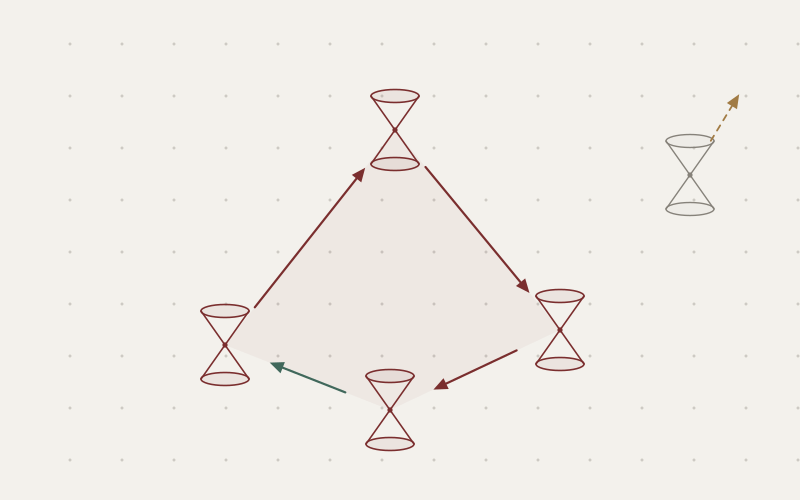
Physics has a good habit of studying one thing at a time: find the point where something happens, zoom in until nothing else is visible, work out what can happen there. The habit usually pays. This essay is about a place where it fails, and the reason is worth knowing: put several singular points into one closed universe, switch on gravity, and a point can change only in step with others, in combinations the whole space allows.
The setting is M-theory, the eleven-dimensional theory that contains the string theories as limits. To get a world with five large dimensions, curl the other six into a Calabi–Yau threefold, the kind of space that was the subject of my doctorate. The shape of the threefold then becomes physics. Each independent class of two-dimensional cycle supplies a force field, a cousin of electromagnetism. A membrane wrapped around a curve is a charged particle, and its mass is proportional to the area of the curve.
Shrink a curve to zero area and its particle becomes massless. That is a phase transition waiting to happen. In 1995 Greene, Morrison and Strominger showed that string theory passes through it smoothly: the massless particles condense, much as electron pairs condense in a superconductor, and on the far side the hidden dimensions have a different topology. A pinch in the threefold, a conifold point, can be opened in two ways, by inserting a small two-sphere or a small three-sphere, and the condensate carries the universe from the first to the second.
Seen up close, every pinch can make this crossing on its own. My four papers on compact Higgs transitions are about what happens when the pinches share a universe. The answer is in the title.
I · Measured together
The word symmetry is older than physics, and it began as something more precise than balance. Greek symmetros meant commensurable, having a common measure, from syn, together, and metron, measure. In the tenth book of Euclid’s Elements, two magnitudes are symmetric when a single measure divides both a whole number of times. The side and the diagonal of a square are the classic asymmetric pair.
Physicists use the word for a transformation that leaves the laws unchanged, and they distinguish two kinds. A global symmetry acts the same way everywhere, and nothing in the theory keeps account of it. A gauge symmetry comes with a field whose job is to measure the charge, as the electric field measures electric charge. The difference shows in a closed space. Field lines leaving a charge must end somewhere, and in a universe without boundary they can end only on other charges, so the total charge of a gauge symmetry in a closed universe is zero. A global charge is under no such obligation.
Near a single pinch, the symmetry carried by the light particles is global. In the language of the papers it is a flavour symmetry of the local theory, and nothing far away measures it. So the condensate can switch on freely. The local geometry is the equation xy − zw = u in four complex variables: u = 0 is the pinch, and any other value of u smooths it away. The parameter is free because nothing outside the neighbourhood cares about it.
II · What gravity gauges
Now zoom out. In the compact threefold, the charge of a wrapped membrane is the homology class of its curve, the record of how the curve pairs with the harmonic two-forms of the whole space. The fields that measure this charge are vectors obtained from M-theory’s three-form, one for each harmonic two-form. Their strength is set by the geometry: the inverse gauge coupling of each vector is the norm of its two-form, and on a compact space that norm is finite. These vectors are dynamical fields of five-dimensional supergravity. They are what the local flavour symmetry looks like from far away. The compact space has gauged it.
The consequence takes one line. Put a light particle at each pinch i, with charge vector qi, an arrow in the lattice of curve classes, and let ti be the size of its condensate, which is the same number as the local smoothing parameter. Supersymmetric vacua require the moment maps of the gauge fields to vanish, and here that condition reads
The condensates, weighted by their charges, must cancel. This is Gauss’s law again, applied to the vacuum: the condensate may not leave a net charge for the shared fields to measure. A pinch can condense only if its arrow can be balanced by arrows elsewhere. The signs in such a relation are no obstacle, because the phases sit in the complex fields and their sizes can always be balanced; only the existence of the relation matters. A curve whose class is independent of all the others carries a charge that nothing can cancel, and its pinch has to stay.
This is the central theorem of the first paper, Global Constraints on Higgsing Localized Five-Dimensional Sectors, and it reaches beyond nodes to cones over del Pezzo surfaces, where the local physics is one of the strongly interacting fixed points E1 to E4, theories with no Lagrangian at all. The compact space gauges their flavour symmetries through a matrix built from membrane charges and divisor pairings, and on every choice of local Higgs component the attainable values of the invariant coordinates are exactly its kernel. For compact threefolds of the stated kind, the same kernel is the image of the global first-order deformations of the geometry. A bookkeeping rule from field theory and a theorem in deformation theory turn out to be one statement.
Readers of Not Enough have met these arrows before, as Friedman’s condition for smoothing nodes: weights, all nonzero, under which the arrows close into a loop. There the rule belonged to the geometer. Here it is Gauss’s law.
The experiment below keeps only the bookkeeping. Each arrow is the charge of the light state at one pinch. Choose which sectors should condense. When the theory allows it, the arrows, scaled by the relation, close into a loop; a sector that cannot join stays behind in gold.
Experiment 01 · Charges that balance
Which sectors can condense?
The universe
Sectors asked to condense
Relation: C₁ − C₂ = 0
Each button is the light state at one pinch, shown with its charge under the shared vectors. Press a sector to add it or take it away.
condenses, scaled by the relationheld: no relation involves itfree once gravity decouples
C₁ and C₂ condense together along C₁ − C₂ = 0. The Higgs branch is locally ℂ²/ℤ₂.
The calculation and its assumptions
Each sector is a free hypermultiplet at a node with an integer charge vector qi, column i of the charge matrix Q. In the compact mode a set of sectors condenses together when Q has a kernel vector that is nonzero on every member of the set; sectors that no kernel vector reaches are held. The loop is drawn with a generic integer relation a, each arrow scaled by ai. With exactly one relation the transverse type is ℂ²/ℤm with m = Σ|ai|, provided the charges span a saturated lattice, as they do in every preset. The Hodge shift is the conifold count: if ρ is the rank of the condensing charges and r the number of relations among them, (h¹¹, h²¹) becomes (h¹¹ − ρ, h²¹ + r). The first three presets are illustrative lattices. The fourth uses the charges of the four light states on the face of X₉ under the three bulk vectors that see them, in the papers’ primitive basis, with their relation C₁ + C₂ − e₁ + e₂ = 0 and the Hodge numbers (6, 122). Rank-three charges are drawn in an oblique projection, which preserves the closing of a loop. “Gravity decoupled” is the fully local limit, in which no shared vector remains dynamical; the second paper shows that some partial limits keep a weaker condition between the two nodes of X₉. The model leaves out the interacting E-type sectors, their local discriminants, the hypermultiplet metric and everything else that is not charge bookkeeping.
Try the last preset, then take away any one of its four sectors. Nothing moves. Every proper subset of those charges is independent, so the only way to condense is all four at once.
The constraint has a precise source, so it can be switched off. Let the threefold grow while every local scale stays fixed, the areas of the shrinking curves and the size of the del Pezzo surface. In local units the Planck mass runs to infinity and gravity decouples. In the explicit example of the second paper, along every such path some combination of the classes that tie the sectors together acquires an infinite norm, and its coupling to the local fields goes to zero. The joint constraint is lost; at most a weaker condition between the two nodes survives. The toggle in the experiment goes all the way to the fully local limit, where every sector is free. The papers call the cooperation what it is, a gravitational effect.
There is an old expectation behind this. Banks and Dixon argued in 1988 that string theory has no continuous global symmetries; Banks and Seiberg later argued that quantum gravity admits no exact global symmetry at all, and Harlow and Ooguri proved it for theories with holographic duals. On this view the nearest thing to a global symmetry that gravity allows is a gauge symmetry with a very weak coupling. These transitions show both halves in one geometry: at finite Planck mass the flavour symmetries are gauged and the sectors are bound together; decouple gravity and they separate.
III · Three sectors, one direction
The second paper, Bulk Gauging and Quantum Couplings across a Compact Higgs Transition, works out one example completely. Its singular threefold, which the papers call X9, has two nodes and a cone over the del Pezzo surface of degree seven, the plane blown up at two points. The cone engineers the rank-one E2 theory, a strongly coupled five-dimensional field theory with no Lagrangian description. Taken alone, each of the three sectors has a Higgs direction.
In the compact space their classes obey one integral relation, R = C1 + C2, where C1 and C2 are the curves at the two nodes and R is the image of the flavour root of the del Pezzo surface. Two bulk vectors see all three sectors. Every first-order deformation of X9 satisfies u1 + s = u2 + s = 0, where u1 and u2 smooth the nodes and s smooths the cone. Smooth one and you have smoothed all three. The papers call this cooperative Higgsing: a global deformation moves several sectors, and none of them can move alone. Across the transition the Hodge numbers change from (6, 122) to (3, 123). Three vector multiplets disappear, two eaten by the rank-two gauging and the third the Coulomb direction of the E2 sector, and one neutral hypermultiplet appears.
My working life is divided between mathematics and a systematic investing business, and the second has left me with a reflex: every position has another side, and the books have to balance. Luca Pacioli printed the rules of double-entry bookkeeping in Venice in 1494. A compact threefold keeps its books by the same rule: no credit at one pinch without a matching debit elsewhere.
The first paper’s examples show the other ways the books can refuse to balance. In one compact model with a single E2 cone, the local theory has its Higgs branch, but the compact kernel is zero: no global deformation reaches the cone, and it cannot be smoothed at all. In another, with twenty-six nodes, two E2 points and two E3 points, every singularity can be smoothed locally, yet on no choice of branch can all thirty move together, because two of the nodes and both E2 points are forced to stay. Local possibility is not global permission.
The second paper also follows the transition into its quantum geometry. On an auxiliary circle the transition carries four light conifold states, and after an explicit continuation of all eight regular periods, the couplings of the surviving vectors agree with those of the smooth threefold on the far side, down to the constant term of the prepotential.
IV · Gravity removes the knob
Without gravity, the light particles of a transition live on a flat hyperkähler space, and the Higgs branch is a hyperkähler quotient: impose the moment-map equations, then divide by the symmetry. Such quotients come with a dial. The equations say that the charge-weighted condensates sum to zero, but the zero may be replaced by a constant, the Fayet–Iliopoulos parameter, introduced by Fayet and Iliopoulos in 1974. Turn the dial and the singular point of the Higgs branch is resolved or deformed; for the flat model of X9, a generic setting gives one of Kronheimer’s smooth asymptotically locally Euclidean spaces.
Gravity changes the space the particles live on. Bagger and Witten showed in 1983, in four dimensions, that hypermultiplets coupled to supergravity must take values in a quaternionic Kähler manifold, whose scalar curvature is fixed by the Planck mass and vanishes only when gravity is switched off; the same holds in five. For the compact threefolds of interest nobody knows this metric. The fourth paper, The Higgs Branch of a Compact Calabi–Yau Transition at Finite Planck Mass, asks what can be said without it, and it starts from an observation that is almost too simple: on a quaternionic Kähler manifold the moment map has no constant of integration.
There is no dial. At a point fixed by the gauge group, the value of the moment map is determined by how the group acts on the tangent space there. A nonzero value would mean that the group rotates the three complex structures, which in supergravity is a gauging of the R-symmetry, not a parameter anyone may choose. So when the moment map vanishes at a fixed point, no choice of level can smooth the singular Higgs branch there. Its shape is decided by the charges.
The paper turns this into a local normal form for quaternionic Kähler quotients. Near a fixed point where the moment map vanishes, and under a freeness condition, the quotient is locally the fixed set times the flat hyperkähler quotient of the tangent representation, with relative corrections to the metric of order r² at distance r. The exponent is two rather than one for a pleasing reason. Along a geodesic leaving the fixed point, the moment map agrees with the flat one up to terms of fourth order, with no cubic term, because the vector field generating the symmetry is a Jacobi field that vanishes where it starts. Gravity bends the space of vacua. It does not change the shape of its singular point.
The physical theorem follows. Suppose that on a face at the boundary of the Kähler cone, where every gauge coupling stays finite, exactly k disjoint curves of the simplest kind, (−1,−1)-curves, have zero area, and that their classes satisfy one primitive relation Σ ai[Ci] = 0 with every ai nonzero. Then, under a regularity hypothesis on the effective supergravity, the Higgs branch opened by the k light states is locally a smooth factor times ℂ²/ℤm, with m = Σ|ai|, exactly as without gravity. The hypothesis says, roughly, that a smooth effective description containing the k light states exists, and that the Coulomb branch through the meeting point consists of supersymmetric vacua.
X9 has such a face. On it exactly four curves have zero area: the two nodal curves and the two exceptional curves e1, e2 of the del Pezzo surface. Their relation is C1 + C2 − e1 + e2 = 0, so m = 4, and the Higgs branch carries ℂ²/ℤ4, the A3 surface singularity XY = s⁴. It is the last preset in the experiment. Gravity neither removes the singular point nor changes its type.
Greene, Morrison and Vafa found ℂ²/ℤk in 1996 for k hypermultiplets with one relation of unit coefficients, and expected its qualitative features to survive gravity. The fourth paper proves the five-dimensional version under its hypothesis, and the four-dimensional statement they expected for the smoothings it treats, under an additional identification. A census of toric hypersurfaces found 5,605 faces whose light spectrum has a single relation, 372 of them with k ≥ 3. Every coefficient was ±1, so m = k throughout. Whether a face with m ≠ k exists at all is open.
For the physicist
Take light hypermultiplets (φi, φ̃i), i = 1, …, k, with charges qi ∈ ℤn under the bulk vectors. In one complex structure the triplet moment map has complex part μℂ = Σi qi φiφ̃i and real part μℝ = Σi qi(|φi|² − |φ̃i|²). The invariant coordinates ti = φiφ̃i are the conifold smoothing parameters, so vacua project into ker Q, and every point of the kernel lifts to the zero locus of the real equation. That is why the signs in a relation never obstruct.
With one primitive relation a and a saturated charge lattice, the torus Tk−1 acts freely on μ0−1(0) ∖ {0}, and ℍk///Tk−1 = ℂ²/ℤm, with coordinate ring ℂ[X, Y, s]/(XY − c sm) and m = Σ|ai|. With nodes alone, Higgsing removes ρ = rank Q vector multiplets and leaves r = k − ρ neutral hypermultiplets, so (h1,1, h2,1) becomes (h1,1 − ρ, h2,1 + r).
The first paper extends the kernel statement to the E1–E4 cones, where the local coordinates are flavour moment maps, and the smoothing criterion adds local discriminants: on an E3 plane, for instance, H1H2(H1 − H2) ≠ 0. The normal form of the fourth paper holds for either sign of the scalar curvature.
V · What cannot condense is confined
A condensate of electric charge has a famous antagonist in magnetic flux. Walther Meissner and Robert Ochsenfeld found in 1933 that a superconductor expels magnetic fields. In 1957 Alexei Abrikosov showed that in some superconductors the field gets in anyway, squeezed into thin tubes that each carry one quantum of flux. Exchange the roles of electric and magnetic and you have the picture of quark confinement that ’t Hooft and Mandelstam proposed in the 1970s: a condensate of magnetic charge squeezes the electric field between quarks into strings, and nothing coloured can be pulled out alone.
The compact transition has its own version, computed in the third paper, Magnetic Sheaves and Stability Walls in a Compact Calabi–Yau Transition. Once the four light states have condensed, a magnetic charge acquires a winding vector, its pairings with the four condensing charges, and these windings lie in the lattice of integer four-vectors whose entries sum to zero. For the magnetic probes the paper constructs, the windings do not cancel. None of them can survive as an isolated particle at a generic point of the Higgs branch, and the flux has to be carried by strings. Greene, Morrison and Vafa described this mechanism in conifold transitions in 1996 and called it a geometric realization of confinement; the paper finds it at work in this compact example.
The paper is careful about what this establishes. It proves two sheaves stable with contribution +1 each, determines a phase sign at the quantum transition, and excludes the emission of the known light particles on a final stretch of the path. These are component counts and partial wall constraints, not a determination of the physical spectrum at the endpoint. Neither the tension of the flux strings nor whether they are supersymmetric follows from the charge calculation.
Coda · The other side
Every pinch in a Calabi–Yau threefold looks free from close enough. That is the deceptive thing about local analysis: it is correct, and it answers a different question. The local theory knows its own symmetry. Only the compact space knows how that symmetry is measured against the others, which is to say that only the whole space knows what symmetric means in Euclid’s sense. Gravity is the reason the measuring happens at all.
In the room where I run money, the first question about any position is who holds the other side. A compact threefold asks the same question of every charged singular point. Where the answer is someone, the points move together. Where it is nobody, the point stays where it is.
Sources
- Euclid, Elements, Book X, Definition 1.
- B. R. Greene, D. R. Morrison and A. Strominger, “Black hole condensation and the unification of string vacua”, Nuclear Physics B 451 (1995).
- B. R. Greene, D. R. Morrison and C. Vafa, “A geometric realization of confinement”, Nuclear Physics B 481 (1996).
- J. Bagger and E. Witten, “Matter couplings in N = 2 supergravity”, Nuclear Physics B 222 (1983).
- P. Fayet and J. Iliopoulos, “Spontaneously broken supergauge symmetries and Goldstone spinors”, Physics Letters B 51 (1974).
- P. B. Kronheimer, “The construction of ALE spaces as hyper-Kähler quotients”, Journal of Differential Geometry 29 (1989).
- T. Banks and L. J. Dixon, “Constraints on string vacua with space-time supersymmetry”, Nuclear Physics B 307 (1988).
- T. Banks and N. Seiberg, “Symmetries and strings in field theory and gravity”, Physical Review D 83 (2011).
- D. Harlow and H. Ooguri, “Symmetries in quantum field theory and quantum gravity”, Communications in Mathematical Physics 383 (2021).
- W. Meissner and R. Ochsenfeld, Naturwissenschaften 21 (1933); A. A. Abrikosov, Soviet Physics JETP 5 (1957).