Every physicist learns to say that a theory “breaks down” at a singularity. It is a fine sentence for ending a lecture and a poor one for starting an argument, because it does not say what broke.
There are at least two candidates. A theory can run out of spacetime. Follow a collapsing star in general relativity and the curvature grows without bound, while the paths of falling observers end after a finite stretch of their own time, with nowhere further for the equations to take them. Or a theory can run out of answers. The geometry is calm, the equations behave wherever they apply, and still the theory cannot say what happens next, or says it in a form from which the past can no longer be read back.
Physics has one word for both, and read closely, the word suits the second failure better. Latin singularis means one at a time, single, alone. A theory keeps its promise when the future it predicts is singular in exactly that sense: one present, one future. What I call an informational singularity is the place where the future stops being singular.
In a recent paper I argued that the two failures pose separate questions: neither implies the other, simple examples separate them in both directions, and the most celebrated result in black-hole physics of the past decade is best read as progress on the second question while the first remains open. This essay makes the argument without the channel algebra, and with a dome on which nothing needs to be pushed.
I · The demon’s contract
In 1814 Laplace described an intelligence that knew, at a single instant, every force acting in nature and the position of every body, and was vast enough to submit those data to analysis. For such an intelligence nothing would be uncertain; the future, like the past, would be present to its eyes. Later writers called it a demon. Laplace was content with une intelligence.
It is better read as a contract than as a creature. Give me the present exactly, the contract says, and I will give you the future exactly. The verb is well chosen: determine comes from terminus, the Roman boundary stone, and a deterministic theory is one in which the present sets the boundary stones of the future.
A contract can be breached in more than one way, and the useful thing is to say which. Feraz Azhar and Mohammad Hossein Namjoo did this for general relativity. A theory can fail to specify the future state at all, which they call non-existence. It can allow several inequivalent futures: non-uniqueness. Or it can supply a future that violates a condition we demand of it, which they call incoherence. Against that list, “the theory breaks down here” is a report that some clause failed, with the clause left blank.
My contribution is to carry the list into quantum theory, where the contract becomes a map from input states to output states, and to make explicit the clause the black-hole debate has always been about: whether the input can be recovered from the output. First, though, it is worth seeing how badly the contract can fail in the theory Laplace had in mind.
II · A dome with many futures
The cleanest breach I know needs ordinary gravity, Newton’s second law and one frictionless mass. John Norton introduced it in 2003, in a paper arguing that causation is a folk science rather than a fundamental principle of nature, and defended it at length in 2008.
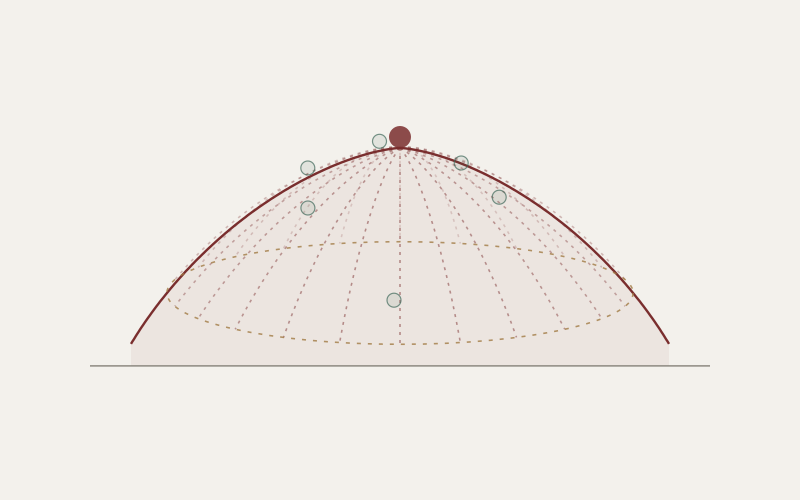
Take a radially symmetric dome whose surface falls below its apex by h = (2/3g) r3/2, where r is distance measured along the surface from the apex and g is the acceleration of gravity, in units chosen so that no other constant appears. The only force along the surface is the downhill component of gravity, g sin θ, where θ is the local slope. Since sin θ = dh/dr = r1/2/g, Newton’s second law for a unit mass reads
d²r/dt² = √r.
Place the mass at rest exactly at the apex. The expected future is that it stays there: r(t) = 0 for all time. Here is another future, one for every waiting time T:
r(t) = 0 for t ≤ T, r(t) = (t − T)⁴ / 144 for t ≥ T.
Differentiate twice and you get (t − T)²/12, which is the square root of (t − T)⁴/144. At t = T the position, the velocity and the acceleration all vanish, so the two pieces join without a seam. The mass sits for as long as it pleases, then leaves in whatever direction it pleases, and Newton’s law holds at every instant of the history.
In one sentence: a single initial state is followed by infinitely many futures, one for each departure time and direction, plus the future in which nothing happens. The implication is sharper than it looks. Newtonian mechanics does not merely fail to say which future occurs; it does not assign them probabilities either. Nothing causes the departure, nothing forbids it, and the theory has no opinion about when.
Experiment 01 · Norton’s dome
One past. How many futures?
The random button is the page’s choice, not Newton’s. The theory assigns these futures no probabilities.
Every history starts the same way: at the apex, at rest, at t = 0. This one left at T = 2.0 toward 30°. At t = 7.0 it is 4.34 from the apex, accelerating at exactly √r. Newton’s law holds at every instant.
The calculation and its assumptions
Units are chosen so that the equation of motion is d²r/dt² = √r, with r the distance from the apex measured along the surface. The surface falls h = (2/3g) r3/2 below the apex; in these units g is a free shape constant, set to 3 here. Departing histories are r(t) = (t − T)⁴/144 after the waiting time T; the faint curves show T = 0, 1, …, 8. A sliding mass stays on the surface only while the normal force g cos θ − v²κ is positive, where κ is the curvature of the profile and v² = (4/3) r3/2 by energy conservation. That holds out to r = 0.6g² = 5.4, marked in gold, about 5.28 time units after departure; the model stops there, because beyond it the mass is airborne and the dome is irrelevant. The mass is a frictionless point on a rigid surface, as in Norton’s treatment. The side view is an orthographic projection; the small disc shows the dome from above.
The textbook guarantee of uniqueness, the Picard–Lindelöf theorem, asks that the force change no faster than in proportion to the change in position, a Lipschitz condition. The dome’s force violates it at exactly one point. Near the apex the ratio √r / r = 1/√r grows without bound: a vanishingly small displacement produces a disproportionately large push, enough for the mass to leave a point of equilibrium in finite time. Nowhere else on the dome does anything unusual happen.
It is tempting to picture a perfectly smooth dome. In the geometer’s sense it is not one, and for this essay the difference matters. The surface has a tangent plane at every point, so there is no kink to blame, but the second derivative d²h/dr² = 1/(2g√r) is infinite at the apex, and with it the curvature of the surface; the Gaussian curvature grows like 1/r. Norton himself is scrupulous on the point. He lists the curvature singularity among the dome’s idealizations and defends it, observing that a surface with a tangent everywhere is better behaved than the sharp edge of a tabletop, which mechanics texts use without apology. He also makes the decisive observation: a dome with finite curvature at its apex keeps the mass there forever. Indeterminism enters only in the limit of infinite curvature.
So on Norton’s dome the two failures share an address. The geometry misbehaves at the apex, and the apex is exactly where the future stops being singular. In classical physics the two failures usually travel together, which is why one word could serve for both for so long.
For the mathematician
Energy conservation for a departure from rest gives ṙ² = (4/3) r3/2, so ṙ = (2/√3) r3/4. Because ∫0 dr / r3/4 converges, a solution can leave r = 0 after any waiting time; for a Lipschitz right-hand side the corresponding integral diverges logarithmically and the rest solution is the only one. The curvature singularity is mild in a precise sense. By Gauss–Bonnet, the total curvature of the cap out to r is 2π(1 − cos θ(r)), finite, although the Gaussian curvature itself behaves like 1/(2g²r) at the apex.
III · Two failures, two addresses
Black holes are where the two failures move apart.
Start with the geometry. Inside a Schwarzschild black hole the Kretschmann scalar, a measure of tidal curvature, is K = 48G²M²/(c⁴r⁶), which diverges as r goes to zero, and every infalling observer reaches r = 0 within a finite proper time. Strictly, r = 0 is not a place in the spacetime at all; it is an edge where the spacetime stops. That is the geometric failure, and it sits at the end of every infalling path.
Then Hawking. In 1974 he showed that black holes radiate, at a temperature ħc³/(8πGMkB), with a spectrum that looks thermal. While the hole evaporates, the radiation is in a mixed state, and that alone is innocent: the radiation is entangled with what remains behind, and part of an entangled whole is always mixed. In 1976 Hawking pushed the calculation to its end. If the hole evaporates completely and the radiation is all that remains, a pure initial state finishes as a mixed one. No unitary evolution can do that, and Hawking proposed replacing the S-matrix of scattering theory with a superscattering operator that maps density matrices to density matrices.
The title of the paper repays attention. The preprint that circulated from Caltech in August 1975 was called “Fundamental Breakdown of Physics in Gravitational Collapse.” By the time it appeared in Physical Review D the next year, as “Breakdown of Predictability in Gravitational Collapse,” the breakdown had narrowed from physics to predictability. The narrower title is the more accurate one. Hawking had not found a new failure of geometry. He had found the second failure, and it showed up where the radiation is collected, far from the hole, where spacetime is as flat as it gets. More precisely, it has no location at all. It lies in the relation between what went in and what came out, and a distant detector sits in perfectly calm surroundings while the relation fails.
His conclusion rested on premises that the mixedness of the radiation does not supply: that evaporation is complete, that no remnant or other sector keeps the correlations, and that the radiation is the entire final output. The arguments over those premises fill a library. For present purposes the point is structural. In Hawking’s account the geometric failure sits inside the horizon, the informational failure is a property of the map from collapse to radiation, and different calculations diagnose them.
IV · Entropy is a poor witness
To say precisely what the second failure is, the paper replaces the demon’s contract with three clauses for a quantum theory. Declare an input system and a complete output. The theory must supply a quantum channel from one to the other; its full specification must select one such channel; and there must be a recovery channel that undoes it on every input in the declared domain, including the input’s correlations with systems outside. Existence, uniqueness, recoverability. A failure of these, on the hypothesis that the output really is complete, is what I call an informational singularity.
The third clause is the one at stake, and it cannot be read off an entropy. Consider the channel that replaces every input with the same pure state. It is perfectly unique, every output is pure, its entropy bookkeeping is immaculate, and it has destroyed everything. A channel that attaches a fixed noisy register to its input does the opposite: the entropy rises and nothing is lost, since discarding the register returns the input untouched. Entropy can rise without loss and stay at zero through total erasure. A quantity that misleads in both directions is evidence to be weighed, never a verdict.
The same holds for the most famous diagnostic in the subject, the Page curve. In Not Enough I described two processes with the same radiation entropy at every moment, one of which returns a diary thrown into the black hole while the other quietly erases it.
With the questions separated, any description of a physical process can be sorted by two answers: whether its geometry holds up, and whether its evolution preserves what went in. The grid below does the sorting. It classifies descriptions by what they establish, not black holes, and its most instructive feature is that one physical process changes cells when the calculation improves.
Experiment 02 · Two questions, four cells
Where does each failure live?
On Norton’s dome the surface’s curvature diverges at the apex, and the apex is the only place where uniqueness fails; a dome with finite curvature there keeps the mass at rest forever. The dome’s geometry is that of a surface in ordinary space, not of spacetime. Hawking’s semiclassical description of evaporation also carries both failures: the classical interior ends at a curvature singularity, and the radiation loses the map.
In Hawking’s calculation the evaporating black hole carries both failures: a singular interior and a lost map.
What the grid does and does not claim
The cells sort descriptions by what they establish. They do not classify physically realized quantum black holes, and they do not show that geometric singularity and fundamental information loss vary independently in a complete theory of quantum gravity, which may tie them together more tightly than present calculations reveal. “Information preserved” means existence, uniqueness and recoverability on a declared input domain with a declared complete output; for the island calculation it means evidence for those clauses, in the form of an entropy curve and reconstruction on a specified code. The two toy entries come from the paper and are artificial by design: they show that neither diagnosis implies the other.
V · What the wormholes repaired
For more than four decades the evaporating black hole sat in the corner where both failures meet. Its classical interior ended at a curvature singularity, and Hawking’s calculation lost the map. Then, in 2019, semiclassical gravity produced a second answer.
The island formula computes the entropy of the radiation R by extremizing, over candidate regions I, the quantity Area(∂I)/4G + S(R ∪ I), and taking the smallest result. Early in the evaporation the best candidate is the empty region, and the entropy rises as Hawking found. After the Page time a region inside the black hole, the island, takes over. It is counted together with the radiation, and the entropy turns down, as Don Page had argued in 1993 it must for a process that preserves information. Geoff Penington and, independently, Ahmed Almheiri, Netta Engelhardt, Donald Marolf and Henry Maxfield found this late branch; within months two groups derived it from the gravitational path integral, where geometries joining different replicas of the black hole, the replica wormholes, supply the new contribution. One of those groups, Penington, Stephen Shenker, Douglas Stanford and Zhenbin Yang, went further and showed how operators behind the horizon can be reconstructed from the radiation, on a specified code and with stated errors.
Now read the result against the grid. The calculation makes questions about the radiation answerable, and the reconstruction work comes close to the recoverability clause on a declared code. Neither says anything about the high-curvature end of the interior. They do not remove the singularity, and they do not show that a fundamental one survives; the interior is simply not what the calculation is about. That is informational progress with no geometric completion attached, the clearest case I know of the two questions coming apart in practice as well as in principle. The black hole changes cells. The physical process is the same; only the calculation has improved.
All of this is evidence, and the word is chosen with care, because the subject attracts overstatement in both directions. A Page curve is what an information-preserving process should produce, but the replacement channel shows that agreement with one output statistic cannot certify a map. Reconstruction on a code is stronger evidence, with a domain and an error attached. And there is the ensemble question. In 2019 Phil Saad, Shenker and Stanford showed that JT gravity, a two-dimensional model much used in this work, is equivalent to a matrix integral, so that connected wormholes encode correlations across an ensemble of quantum systems rather than the behaviour of a single one. A known average of channels is itself one perfectly definite channel, so this is no failure of the uniqueness clause. The open question is how the average relates to any single microscopic theory. Until it is answered, a completion established for the average is not yet a completion for one theory.
I spend my working days deciding which numbers to believe about investment strategies, and the mistake these caveats guard against has a familiar shape there. A good track record is one statistic of one history. It is consistent with skill, it is required of skill, and luck produces it often enough that nobody sensible certifies a process on that alone.
VI · The censor’s other job
In 1969 Roger Penrose asked whether there might be a “cosmic censor” that forbids naked singularities, clothing each one in an event horizon. The question became two conjectures. Weak cosmic censorship holds that the singularities of generic gravitational collapse are hidden from distant observers. Strong cosmic censorship holds that the spacetime determined by generic initial data cannot be extended beyond the region those data determine, so that no Cauchy horizon opens onto a future the present failed to fix. The strong version is Laplace’s contract restated for general relativity. It does not promise that curvature stays bounded or that every observer’s history continues, and it says nothing about quantum information.
The Roman censor had two jobs. He supervised public morals, and he took the census, the register of every citizen and his property. Both words come from censere, to assess. Penrose’s censor inherited the first job: he guards decency and cares about what may be seen in public. The proposal at the end of my paper gives him the second. Informational cosmic censorship asks that, for a declared class of gravitational processes, the complete theory supply a unique evolution from which every input can be recovered: an accounting in which every distinction between possible inputs is still on the register at the end, whatever happened to the geometry along the way.
I offer it as a conditional research principle that complements the classical conjectures rather than replacing them, and it does not follow from the Page curve. Its use is that it states the dynamical claim a resolution of the information problem has to make, and lets each calculation say exactly how much of that claim it has established: an entropy history for one preparation, recovery on a code, or a complete microscopic evolution. Those are three different achievements, not three drafts of the same one.
A theory can run out of spacetime, or it can run out of answers. The first failure has a location. The second has only a ledger, and it can occur in perfectly flat surroundings. Laplace published his intelligence in 1814; eighteen years earlier he had described stars so massive that their light could not escape. He never had to ask what the one would make of the other.