There is a strange habit at the centre of modern geometry. To learn about a space, you choose an equation, gather every solution of it into a new space, and then study that new space mostly where it fails to be complete. The solutions that teach you the most are the ones in the act of falling apart.
The new space is called a moduli space. The word goes back to Riemann, who showed in 1857 that a surface of genus p depends on 3p − 3 continuous parameters and called them its Moduln. A modulus is a little measure, the diminutive of the Latin modus. The name suits the parameters better than the spaces they grew into. Modern moduli spaces are rarely little, almost never compact, and most informative exactly where they stop.
Several of my recent manuscripts are about such edges: where instantons concentrate into points, where a piece of a three-manifold collapses into a boundary condition, where a family of solutions grows a bubble on a seam. Written out, the longest runs past two hundred pages. Stripped down, each rests on one move, and the move is old enough to be explained with a doughnut and some water. Invariants are made from broken things. More precisely, an invariant is a census of the ways solutions can break, together with a proof that the census balances.
I · Let the water run downhill.
Stand a doughnut on its edge and pour water over it. The water runs downhill along the steepest path, and there are exactly four places where it can come to rest: the top of the outer rim, where every direction leads down; the top and the bottom of the hole, which are saddles, downhill in one direction and uphill in the other; and the bottom of the outer rim, where nothing leads down at all. In the 1920s Marston Morse showed that such points encode the shape of the surface. The way the flow connects them entered the story later, through Thom, Smale and Witten.
The modern form of the idea is a piece of bookkeeping. Each resting point becomes a generator, graded by its index, the number of independent directions that lead down: two at the summit, one at a saddle, none at the bottom. A map ∂ then sends each point to the points one index lower, weighted by the number of flow lines that run from one to the other.
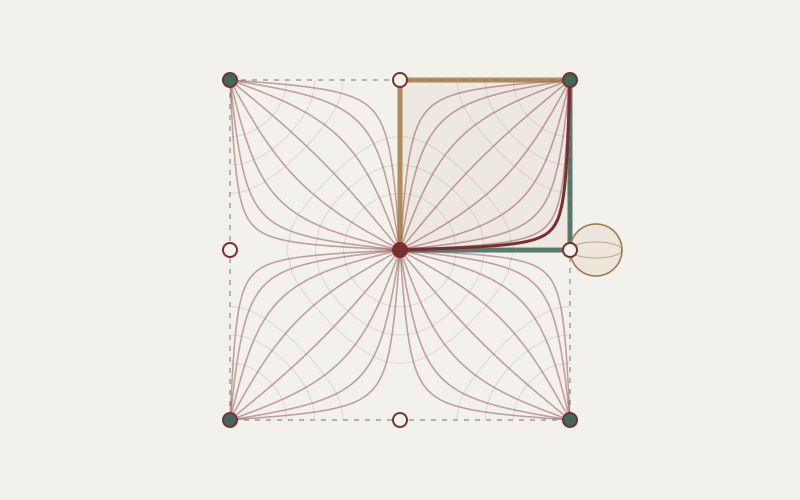
A standing doughnut is hard to draw on a flat page, so the experiment below flattens it. Take a square and glue its left edge to its right edge and its top edge to its bottom edge; the result is the same surface. Give it the height cos x + cos y. The summit sits in the middle. The bottom sits at the corners, which the gluing turns into a single point. The two saddles sit at the midpoints of the edges: S₁ on the left and right edges, S₂ on the top and bottom.
Water leaving the summit reaches the bottom along four kinds of path, one for each quadrant of the square. Along every such path the coordinates satisfy tan(y/2) = C·tan(x/2) for a fixed positive number C, and each positive C gives exactly one path. So each quadrant holds a family of flow lines with a single parameter: an open interval of them. Push C towards zero and the line clings to the horizontal axis almost all the way to the saddle S₁ before turning up the edge to the bottom. In the limit it breaks into two flow lines, summit to saddle and saddle to bottom, joined at a point where the water has stopped. Push C towards infinity and the same thing happens through S₂.
Experiment 01 · The ends of a family
Follow a family to its broken ends.
The square is a torus: its left and right edges are one circle, its top and bottom edges another. Choose a family with the buttons or by tapping a quadrant. The numbers beside the axes and edges count the flow lines from the summit to each saddle and from each saddle to the bottom.
flow linebroken end through S₁broken end through S₂
∂(max) = (1 − 1) S₁ + (1 − 1) S₂ = 0; ∂S₁ = ∂S₂ = (1 − 1) min = 0
The north-east family. C = 0.061: the line runs close to the horizontal axis and turns near S₁. The family’s two ends break through S₁ with sign +1 and through S₂ with sign −1. With signs they cancel.
The calculation and its assumptions
The torus is the square [−π, π]² with opposite edges identified, and the height is f(x, y) = cos x + cos y, with its maximum at (0, 0), saddles at S₁ = (π, 0) and S₂ = (0, π), and minimum at (π, π). Water follows the negative gradient, ẋ = sin x, ẏ = sin y. Separating the variables gives d log tan(x/2) = d log tan(y/2) in the first quadrant, so tan(y/2) = C·tan(x/2); explicitly x(t) = 2 arctan(eᵗ) and y(t) = 2 arctan(C eᵗ). The other quadrants follow by symmetry. The figure draws these exact curves; the faint closed curves are level sets of the height. Signs come from oriented unstable manifolds: dx∧dy at the maximum, ∂/∂y at S₁, ∂/∂x at S₂. A flow line from p to q receives the sign that compares its velocity, followed by the orientation at q, with the orientation at p; a broken trajectory receives the product of its two signs. Other choices of orientation change individual signs but never the cancellations. The slider runs over C from e⁻⁷ to e⁷. No flow line joins the two saddles, so the counts are those of the Morse–Smale–Witten complex.
II · The census of ends.
The derivation fits in a paragraph. Apply ∂ twice to the summit. The coefficient of the bottom in ∂²(summit) is a sum over the saddles: the number of flow lines from the summit to the saddle, times the number from the saddle to the bottom. Each product counts broken trajectories, summit to saddle and then saddle to bottom. On the torus there are two flow lines from the summit to each saddle and two from each saddle to the bottom, so eight broken trajectories in all. Now count the same eight from the other side. Every broken trajectory is the end of exactly one family of unbroken flow lines; that is the gluing theorem. Every family, being an interval, has exactly two ends; that is the compactness theorem. Four families, eight ends. The two ends of an interval carry opposite orientations, so with signs they cancel, and ∂² = 0.
In one sentence: ∂² = 0 says that a compact oriented one-dimensional space has as many ends pointing in as pointing out. The consequence is the whole subject. Because ∂² = 0 one can form homology, the cycles modulo the boundaries, and the same argument run one dimension higher, on families of families traced out as the height function is deformed, shows that the homology does not depend on the height function at all. It belongs to the surface.
On the torus every count cancels. The summit sends two flow lines to each saddle, arriving with opposite signs, and each saddle sends two to the bottom, again with opposite signs. The differential is zero and the homology is ℤ, ℤ², ℤ: one generator for the surface, two for its independent loops, one for a point. For a differential that is not zero, dent a sphere so that it has two summits, a pass between them and one lowest point. Each summit sends a single flow line to the pass, so ∂ ≠ 0. The pass sends two flow lines to the bottom, down opposite slopes, and they cancel. The flow lines from one summit to the bottom form a circle of directions with one removed, the one that leads to the pass, and both ends of that interval break at the pass before continuing down opposite sides. Again ∂² = 0, and the homology is ℤ, 0, ℤ, as a sphere’s should be.
Students usually meet ∂² = 0 as an axiom, accompanied by the slogan that the boundary of a boundary is empty. The slogan is true and explains nothing. In Morse theory the identity is a theorem, and the theorem is a census of broken things.
For the mathematician
For critical points p and r with ind p − ind r = 2, the space of unparametrised flow lines from p to r, compactified by broken trajectories, is a compact oriented one-manifold whose boundary is ⨆q 𝓜(p, q) × 𝓜(q, r), the union over critical points q of intermediate index. Its signed count of boundary points is ⟨∂²p, r⟩, which therefore vanishes. Gluing supplies the collar at each broken end; compactness supplies the boundary.
Torus: C₂ = ℤ⟨max⟩, C₁ = ℤ⟨S₁, S₂⟩, C₀ = ℤ⟨min⟩ and ∂ = 0. Dented sphere: C₂ = ℤ⟨M₁, M₂⟩, C₁ = ℤ⟨S⟩, C₀ = ℤ⟨m⟩, with ∂M₁ = S and ∂M₂ = −S for suitable orientations, and ∂S = m − m = 0. Then H₂ = ℤ⟨M₁ + M₂⟩, H₁ = 0 and H₀ = ℤ.
III · Floer’s infinite doughnut.
In the 1980s Andreas Floer took this argument somewhere it had no right to work. Replace the doughnut by the space of all connections on a three-dimensional manifold Y, which is infinite-dimensional, and replace the height by the Chern–Simons functional. Its resting points are the flat connections. Its flow lines, read correctly, are instantons: solutions of the anti-self-dual Yang–Mills equations on the four-dimensional cylinder Y × ℝ. Every resting point now has infinitely many directions down and infinitely many up, so the index means nothing. Floer saw that the difference of indices along a flow line is still finite, and that the bookkeeping needs nothing more. His instanton homology appeared in 1988, alongside a second theory in which the space is the set of paths between two Lagrangian submanifolds of a symplectic manifold, the resting points are their intersection points, and the flow lines are holomorphic strips. Floer died in 1991, at thirty-four.
Physics had the picture before mathematics had the proof. In his 1982 paper on supersymmetry and Morse theory, Edward Witten read the Morse complex as quantum tunnelling between classical ground states, with the flow lines as the tunnelling paths. Floer made an infinite-dimensional version rigorous, and the price of infinite dimensions turned out to be a second way to break.
IV · Bubbles.
On the doughnut a sequence of flow lines can fail to converge in only one way: it splits into a chain of flow lines, broken at resting points. Instantons have a second option. Karen Uhlenbeck proved in 1982 that a sequence of instantons with bounded energy has a subsequence that converges, after suitable changes of gauge, everywhere except at finitely many points, and that at those points energy concentrates and is lost to the limit in whole quanta. The phenomenon had surfaced a year earlier in her work with Jonathan Sacks on harmonic maps of spheres, where the escaping energy forms a tiny sphere attached at a point. The name bubble stuck.
The cause is a coincidence of dimension. In four dimensions, and only in four, the Yang–Mills energy does not change when a solution is shrunk: an instanton a millionth of the size has the same energy as the original. Nothing prevents a family from shrinking forever, and when it does, the energy has to go somewhere. It goes into a point.
Experiment 02 · A bubble forms
Shrink an instanton.
The curve shows how the energy of a single instanton on four-dimensional space is distributed by distance from its centre. The shaded area is the total energy, one instanton, and it is the same at every scale. The green band marks a fixed ball of radius 0.25.
At scale λ = 0.50, 10.3% of the energy lies within 0.25 of the centre, and half of it within 0.50. The total is one instanton at every scale. Let λ go to zero and the energy collapses onto the point: the limit is flat everywhere else, and one quantum of energy is missing from it.
The calculation and its assumptions
The curve is the charge-one instanton of Belavin, Polyakov, Schwarz and Tyupkin on ℝ⁴, centred at the origin with scale λ. Its action density is proportional to λ⁴/(r² + λ²)⁴. Multiplying by 2π²r³, the volume of the three-sphere of radius r, and normalising the total to one gives the energy per unit radius ρ(r) = 12λ⁴r³/(r² + λ²)⁴. The energy inside radius R is 1 − 3/(1 + t)² + 2/(1 + t)³ with t = R²/λ², which equals one half at R = λ; the peak lies at r = λ√(3/5). In physical units the total is 8π²/g². Only the scale changes here; the centre, the gauge orientation and the flat background are fixed.
A bubble is expensive. The instantons of one unit of charge on four-dimensional space, framed at infinity, form an eight-dimensional family: four parameters for the centre, one for the scale, three for the framing. A bubble therefore removes eight dimensions from any family in which it forms, and in a generic family of dimension less than eight none can form. The differential, and the proof that ∂² = 0, use families of dimension at most one, comfortably out of reach. Operations that need larger families are less fortunate, and that is where my papers begin.
Donaldson’s invariants of four-manifolds, which count instantons, had to manage bubbles at every step. In 1994 Seiberg and Witten introduced equations whose spaces of solutions are compact, and Witten conjectured an exact formula expressing Donaldson’s invariants through the new ones. One route to that formula, proposed by Pidstrigach and Tyurin and developed at length by Feehan and Leness, joins the two theories inside a larger space of SO(3) monopoles containing solutions of both kinds. The formula is read off from the ends of that space near the Seiberg–Witten solutions, and those ends include places where bubbles have formed. My paper on one-bubble neighbourhoods proves an oriented neighbourhood theorem at the first such level, where exactly one bubble has formed, and identifies the orientation it induces with the standard one. Under the topological hypotheses of Feehan and Leness it supplies the analytic input their level-one calculation needs. It does not reach the higher levels, where bubbles collide, and a complete derivation of Witten’s conjecture along this route needs those too.
V · A dictionary that translates the verbs.
Every closed, oriented three-manifold can be cut along a surface into two handlebodies, solid shapes like two thickened pretzels glued along their skins. Poul Heegaard introduced such splittings in his dissertation of 1898. In 1988 Michael Atiyah conjectured that, for an integral homology sphere, Floer’s instanton homology could be read off from a splitting. On the surface, the flat connections form a finite-dimensional space with a symplectic structure. Those that extend over one handlebody form a Lagrangian submanifold, and those that extend over the other form a second. The conjecture says that the Lagrangian Floer homology of this pair, which counts holomorphic strips in a finite-dimensional space, agrees with instanton homology, which counts solutions of a partial differential equation in four dimensions. Two very different languages would then describe the same object.
The mechanism is a change of scale. Shrink the surface until it is tiny compared with the other directions, and an instanton on its four-dimensional neighbourhood becomes, in the limit, a holomorphic curve in the space of flat connections on the surface. Dostoglou and Salamon made one such limit rigorous in 1994. Daemi, Fukaya and Lipyanskiy proved that the two groups are isomorphic in the framed setting I work in, by counting solutions of a mixed equation introduced by Lipyanskiy: anti-self-dual on part of a four-dimensional domain, holomorphic on the rest, the two matched along a seam.
A dictionary that matches nouns is a glossary. Groups are the nouns of this subject, and maps between them are the verbs. A four-dimensional cobordism, a manifold that begins at one three-manifold and ends at another, induces a map between their instanton homologies, and these maps compose as a functor should. In two long manuscripts I prove that isomorphisms of the Daemi–Fukaya–Lipyanskiy type intertwine these maps with maps defined by holomorphic curves alone. The first works over the field with two elements, for every connected cobordism between connected three-manifolds that carries a framed arc and a bundle trivialised along its ends. The second works over the integers, up to chain homotopy and one overall sign for each cobordism, so that on homology the symplectic maps form a projective functor.
The symplectic side of that theorem contains no gauge theory. Its maps count holomorphic triangles, and nothing in their definition guarantees that two ways of cutting a cobordism into handles give the same answer. The comparison supplies the guarantee: independence of the decomposition and functoriality come out of the translation instead of going into it. That is what a dictionary that respects grammar is for. A sentence proved in one language becomes true in the other without a second proof.
The proof is again a census of ends. Its central analytic result is an adiabatic limit in which a compression body, a thickened surface with handles attached along one side, collapses next to a holomorphic strip and becomes the Lagrangian boundary condition of its own flat connections. As the body shrinks, solutions converge to solutions of the limiting problem together with broken trajectories, and in index zero gluing matches the solutions before and after the collapse one to one. A second result, excision along a torus, lets the pieces be cut apart and reassembled.
In March 1940, jailed in Rouen for failing to report for military service, André Weil wrote a long letter to his sister Simone about analogies in mathematics. He described his work as “deciphering a trilingual text”, with number fields in one column, Riemann surfaces in another and function fields over finite fields between them, and admitted that “of each of the three columns I have only disparate fragments”. The Rosetta Stone was worth having because whole sentences on it correspond. The cobordism maps are the sentences.
Sometimes a faithful translation needs a footnote. Both theories carry operations indexed by the homology of the splitting surface: by its loops, by the surface itself, and by a point. Daemi, Fukaya and Lipyanskiy proved that their isomorphism respects the operations of loops and of the surface, and explained why the argument stops at the point: a point insertion needs four-dimensional families of mixed solutions, and those can bubble on the seam. An instanton bubble in the interior costs eight dimensions. A bubble on the seam carries half the energy and costs four, so four-dimensional families are exactly where it appears. My paper on point operations finds every such bubbling end and computes its signed contribution. The point operation translates correctly once the symplectic side is shifted by a multiple of the identity: by 8 when the marked component of the surface has genus one, by 4 in genus two, and by 0 from genus three on. The bubbles are not a nuisance in the proof. They are the footnote.
For the mathematician
Paper I, Theorem A: for every morphism (W, E, ν): M₀ → M₁ of the connected framed cobordism category, all admissible presentations p₀, p₁ and every admissible decomposition d, H(Np₁) ∘ I#(W, E, ν) = Sd(W, E, ν) ∘ H(Np₀) over 𝔽₂. Paper II proves the corresponding identity over ℤ up to chain homotopy and one overall sign for each cobordism, with the instanton maps oriented by almost-complex structures; the relation with homology-oriented integral instanton maps is left open.
Point operations, in the admissible embedded-Lagrangian setting of Daemi, Fukaya and Lipyanskiy: N bqG − bqS N = dSKq + KqdG + cgN, with cg = 8, 4, 0 for g = 1, 2, ≥ 3 in the positive p₁ normalisation, where g is the genus of the component containing q. The identity is integral. When four is invertible, the quarter normalisation gives the shifts 2, 1 and 0.
VI · Running the machine backwards.
The usual direction of travel is fixed: a geometric problem, then an equation, then a moduli space, then a compactification, then algebra. Inverse moduli theory asks how far the arrows can be reversed. Starting from an algebraic structure, it asks which patterns of breaking could produce it, which compactified spaces realise those patterns, and which equations produce those spaces.
In dimension one the answer is exact. Hand someone a chain complex and ask for oriented one-dimensional spaces whose ends are the broken trajectories it prescribes. If d² = 0, the prescribed ends cancel in pairs, and each positive end can be joined to a negative one by an interval. If d² ≠ 0, nothing will do. So d² = 0 is exactly the condition for filling. For flow lines this is folklore; for the A∞ relations, the planar version that governs holomorphic disks, the signs are subtler, and the paper computes them.
Above dimension one the algebra stops being enough. Extending a system of moduli spaces further meets obstructions that are ordinary bordism classes, and some of them are invisible to the algebra. Following Cohen, Jones and Segal, the paper records framed realisations of a two-generator complex with zero differential that differ by η, the generator of the first stable homotopy group of the spheres. One chain complex, two geometries. It is the drum of my essay Not Enough in another key: the algebra is the sound, and it does not determine the instrument.
The paper’s principal result is an obstruction of a more tangible kind. Jim Stasheff’s associahedra organise the ways of bracketing a product: K₃ is an interval joining (ab)c to a(bc), and K₄ is a pentagon whose five corners are the five ways to bracket four letters. A∞ structures, which arise from counting holomorphic disks, are realised by families of moduli spaces shaped like these polytopes, and constructions of such families often carry auxiliary vector bundles, chosen piece by piece and required to match on shared faces. The paper proves that a compatible choice on K₂ and K₃ extends over the pentagon exactly when the bundle it glues together on the pentagon’s boundary extends. Twist one endpoint identification by a reflection, and that boundary bundle acquires a Möbius band, which no disk can fill. Double the twisted choice and the obstruction disappears, since two Möbius bands together form an orientable bundle: one of the few settings in which two wrongs do make a right. The obstruction belongs to the data that were chosen; a larger choice can escape it.
VII · What survives.
The word invariant promises that something survives a change of choices: of height function, of metric, of splitting, of handle decomposition. Each proof of survival in this essay is the same census taken one dimension higher, where the choices themselves move in a family and the broken things are counted again. When the breaks cancel, the result is an invariant. When they fail to cancel by an amount one can compute, as the seam bubbles do in genus one and two, the result is an invariant with a footnote.
One hopes that a single solution will be smooth, unique and well behaved. An invariant asks for an exact account of how solutions stop being any of those things, and a proof that the account balances. Counted with that much care, broken things are what survives every change of choice.
Sources
The papers behind each section
IV: One-bubble neighborhoods in SO(3)-monopole moduli spaces. V: Cobordism maps and Atiyah–Floer isomorphisms for framed instanton homology I and II; Point operations and matching-line bubbles in the Atiyah–Floer comparison. VI: Inverse Moduli Theory: Realizability of Degeneration Data by Compactified Moduli Spaces.
Morse and Floer theory
B. Riemann, “Theorie der Abel’schen Functionen”, Journal für die reine und angewandte Mathematik 54 (1857).
E. Witten, “Supersymmetry and Morse theory”, Journal of Differential Geometry 17 (1982).
A. Floer, “An instanton-invariant for 3-manifolds”, Communications in Mathematical Physics 118 (1988); “Morse theory for Lagrangian intersections”, Journal of Differential Geometry 28 (1988).
R. L. Cohen, J. D. S. Jones and G. B. Segal, “Floer’s infinite dimensional Morse theory and homotopy theory”, in The Floer Memorial Volume (1995).
Bubbles
J. Sacks and K. Uhlenbeck, “The existence of minimal immersions of 2-spheres”, Annals of Mathematics 113 (1981).
K. K. Uhlenbeck, “Connections with Lp bounds on curvature” and “Removable singularities in Yang–Mills fields”, Communications in Mathematical Physics 83 (1982).
A. A. Belavin, A. M. Polyakov, A. S. Schwarz and Yu. S. Tyupkin, “Pseudoparticle solutions of the Yang–Mills equations”, Physics Letters B 59 (1975).
E. Witten, “Monopoles and four-manifolds”, Mathematical Research Letters 1 (1994).
The Atiyah–Floer conjecture
M. F. Atiyah, “New invariants of 3- and 4-dimensional manifolds”, in The Mathematical Heritage of Hermann Weyl, Proceedings of Symposia in Pure Mathematics 48 (1988).
S. Dostoglou and D. A. Salamon, “Self-dual instantons and holomorphic curves”, Annals of Mathematics 139 (1994).
A. Daemi, K. Fukaya and M. Lipyanskiy, “Lagrangians, SO(3)-instantons and the Atiyah–Floer conjecture”, arXiv:2109.07032, and “Lagrangians, SO(3)-instantons and mixed equation”, Geometric and Functional Analysis 34 (2024).
A. Weil, letter to Simone Weil, March 1940, translated by M. H. Krieger as “A 1940 letter of André Weil on analogy in mathematics”, Notices of the American Mathematical Society 52 (2005).
Associahedra
J. D. Stasheff, “Homotopy associativity of H-spaces. I, II”, Transactions of the American Mathematical Society 108 (1963).