Wittgenstein, in the Philosophical Investigations, describes someone who buys several copies of the morning paper to assure himself that what it says is true. He puts the remark in parentheses, as if it were too obvious to need the main text. It is the best short description I know of how a firm comes to believe something.
A firm can employ brilliant people, buy excellent data and run sophisticated models, and still struggle with a plain question: why do we believe this? One analyst read the company’s announcement. A second read a broker’s note about the announcement. A third asked a language model to summarize the broker. By the time their views reach the meeting, one observation has acquired three authors and the look of a consensus. Nobody lied. Every copy of the paper was genuine.
Agreement can carry information. How much depends entirely on how it was produced. A room of people who checked different evidence and a room of people who inherited the same premise look identical from the head of the table, and only one of them has learned anything.
The Talmud records a rule that unsettles modern readers: if every judge of the Sanhedrin voted to convict in a capital case, the accused went free. The usual explanation is that a court without a single dissenting voice has heard no defence. I do not recommend the rule to investment committees. I do recommend the suspicion.
I · Count the evidence.
Suppose each analyst estimates the same unknown quantity. Each estimate is unbiased, each has the same error variance σ², and any two errors have correlation ρ. Average n of them. The variance of the average is σ²[1 + (n − 1)ρ]/n. Leslie Kish, who spent a career on sample surveys, called the bracket the design effect, and its reciprocal gives the number that matters: n correlated estimates are worth n/[1 + (n − 1)ρ] independent ones.
In words: correlation charges a fee on every additional voice, and the fee rises with the size of the room. The implication for whoever chairs the meeting is a ceiling. As n grows, the effective count approaches 1/ρ and stops. At a correlation of 0.6, ten analysts are worth about one and a half, and no hiring budget will buy a second independent opinion.
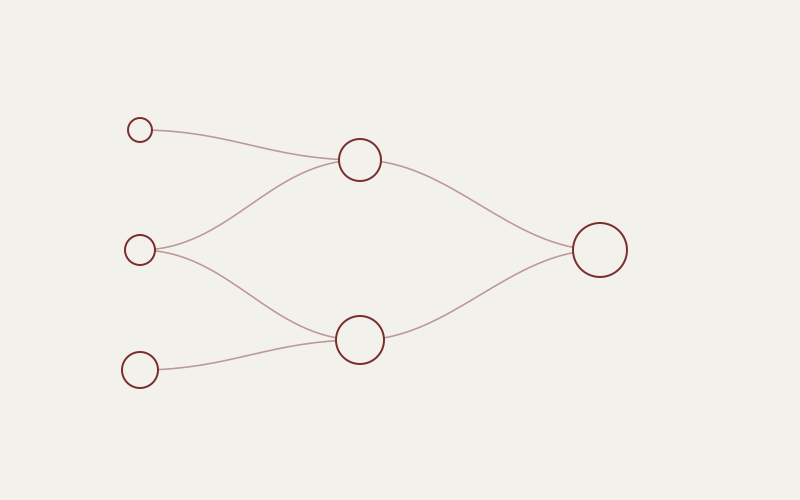
Move the sliders below. The effective count climbs quickly when the errors are independent and stalls almost at once when they are not.
Experiment 01 · The shape of agreement
More voices. How much more evidence?
The lines illustrate shared information. They are not a measured organizational network.
Ten estimates with correlation 0.60 have the averaging precision of 1.56 independent estimates.
The calculation and its assumptions
For n unbiased estimates with individual variance σ² and common pairwise correlation ρ, the variance of their mean is σ²[1 + (n − 1)ρ]/n. The equivalent independent sample size is n/[1 + (n − 1)ρ]. Standard errors are square roots of variances. This illustrative model assumes equal weights, equal variances, and 0 ≤ ρ ≤ 1. It does not model bias, expertise, incentives, or strategic behavior. Correlated errors need not come from a common source; the network is a visual analogy.
II · Keep the trail.
At a correlation of one, adding analysts adds nothing. That case is easy to recognize and therefore rare. The dangerous case sits a little below it: the team grows, the deck improves, the conviction rises, and the evidence barely moves. In the default setting above, treating the ten voices as independent overstates the precision of their average by a factor of two and a half, and nobody in the room is paid to point that out.
The remedy is unglamorous. Keep the evidence attached to the claim: what was observed, what was inferred, which conclusions share a source, and what would change the firm’s mind. The last item is the one most often skipped, for a reason that has nothing to do with oversight. A thesis without a stated condition for being wrong cannot be scored against its author. In the paper I call vagueness what it is, career insurance.
Language models make this better and worse at once. A machine will argue against a senior colleague’s thesis without fearing for its bonus, which no junior analyst can claim. But a critique generated by the same model that wrote the thesis shares its blind spots. Dissent from the same substrate is correlated dissent. However fluent it sounds, it belongs in the experiment with a high ρ.
III · A belief is not yet a position.
A well-supported belief still leaves the decisions open: how large the position, how uncertain the magnitude, how it interacts with the risks already in the book. A firm can be right about an issuer and wrong about the size, or right about both and wrong about the timing. Every portfolio manager has met all three.
Here the organization becomes part of the reasoning. Someone turns evidence into a forecast, the forecast into a position and the outcome into an update, and at each handoff information leaks. The leaks are not random. An analyst believes a credit is attractive provided there is no recession, the company refinances below seven percent and the sector story holds. The portfolio manager hears “we like the name.” The conditions, which were the useful part, go first. A probability becomes an adjective. A conditional claim becomes a headline. An uncertainty becomes somebody else’s responsibility.
Risk management does not catch the loss, because it answers a different question. The risk department asks how much the firm can lose. Somebody also has to ask why the firm might be wrong.
The quality of an institution’s thinking lives partly in what survives between its decisions.
The goal is not agreement. It is a decision whose reasons are still available when the result arrives.
IV · Remember before knowing the ending.
A good outcome does not reveal which part of the reasoning was right, and a bad one does not prove that every part was wrong. In 1975 Baruch Fischhoff showed that people who are told how an event turned out judge that outcome to have been more predictable than people who are not told, and that they cannot discount what they know. He called it creeping determinism. Institutions creep faster than individuals, because their memory is a meeting. Without a record of the original expectations, a firm learns a story that fits the outcome and mistakes it for an improvement in judgment. It accumulates experience without accumulating knowledge.
A useful memory is dull to read: the forecast written before the event, the alternatives considered, the uncertainty admitted, the rule that turned a belief into a position. With it, a firm can later ask whether its probabilities were calibrated, whether its forecasts were informative as well as calibrated, and whether its sizing rule made sense given what was known at the time. A profit-and-loss statement answers none of these questions.
Language models make analysis cheap. They also make explanation cheap, and that is the more dangerous gift. A model will write a fluent, internally consistent account of any outcome, including the one that did not happen. A firm that asks the model that wrote the thesis to write the post-mortem develops, in the paper’s phrase, “a capacity for self-persuasion that scales with its computational resources.”
That is the question behind The AI-Native Asset Manager. When information is abundant and analysis cheap, the scarce resource is institutional epistemology: the architecture by which a firm generates, challenges, sizes and learns from its beliefs. The paper organizes the firm around the lifecycle of a belief rather than around its departments, and calls the result a belief factory.
An institution knows something when it can do more than repeat a conclusion. It can recover the reasons, show which of them share a source, act in proportion and change its mind. Ten copies of the morning paper can do none of these things.