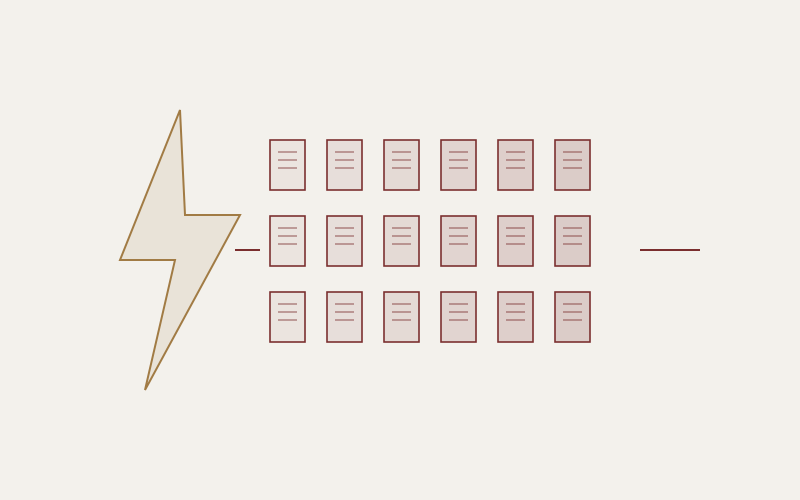
Consider a fleet of computing machines, delivered and waiting. The chips exist. The software runs. There is work to do. And one machine in seven cannot be switched on at the load it was bought for.
The missing input might be electricity. It might be cooling. It might be the connection between a power line and the building where the machines stand. A capability can exist in one sense and be unavailable in every sense that matters to the person waiting for it.
Software hides this well. A model arrives as a file or a service. Its deployment arrives through substations, transformers, chillers, permits and decisions about where all of them will go. The word infrastructure was coined by French railway engineers in the 1870s for the earthworks beneath the track. The most abstract technology of the century turns out to need earthworks.
I · Find the smallest number.
Agricultural chemists found the governing principle two centuries ago. Carl Sprengel stated it and Justus von Liebig made it famous: a crop grows only as far as its scarcest nutrient allows, and more of everything else does nothing. Liebig’s law of the minimum applies to a data hall without modification.
Start with a deliberately simple facility. Every accelerator draws the same power. Electricity caps the fleet that can run, cooling caps it again, and the installed chips cap it a third time. The operating fleet is the smallest of the three numbers. That is the whole model.
Move the controls, or double the installed chips, and watch which changes create capacity and which only create inventory.
Experiment 02 · Capacity is a joint condition
What is actually holding the fleet back?
Capacity supported by each resource, in accelerators. The shortest bar sets the operating fleet.
Cooling capacity limits the initial scenario. About 28.6 thousand installed accelerators cannot operate at the assumed load.
The calculation, units, and limits
Assumed accelerator draw: 700 W. Assumed power usage effectiveness (PUE): 1.25, the ratio of total facility power to IT power. Electricity supports grid MW × 1,000,000 / (1.25 × 700) accelerators. Cooling supports cooling MW IT × 1,000,000 / 700. The operating fleet is the minimum of those two quantities and the installed chips. Useful hours per day equal that fleet × 24 × utilization. Fractional accelerators are a continuous planning approximation.
Every input is illustrative, not a specification for a particular product or facility. The model holds power draw and PUE fixed. It omits non-accelerator IT load, networks, water, reliability, construction time, financing, workload differences, and part-load power behavior. Accelerator-hours measure capacity in this model, not intelligence or economic value. Utilization changes useful work, not the assumed provisioning requirement.
II · More of the wrong thing.
In the power-constrained scenario, doubling the chips doubles the inventory and leaves the operating fleet exactly where it was. In the chip-constrained scenario, more electricity does the same thing from the other side. Both purchases look like investment on a balance sheet. One of them is a warehouse.
The value of an input depends on the others. The same shipment of accelerators transforms one site and sits in its crates at another, and nothing about the shipment tells you which. Anyone who has run a portfolio knows the general form of the problem: the marginal value of a position depends on everything else in the book.
The controls show something less obvious. The bottleneck moves. Widen the grid connection far enough and cooling binds; add cooling and the chips bind. Capacity planning is a sequence of changing constraints, and a plan that maximizes one input in isolation buys the next bottleneck at full price.
Technical possibility becomes operational capacity only when its supporting systems meet.
III · Useful work has another denominator.
The operating fleet is not the same as useful output. Move the utilization slider: the physical capacity stays put and the useful hours change. Scheduling, reliability, the choice of workload and the plain ability to keep a fleet busy decide what a given physical system delivers. Better algorithms change the work done per hour, a quantity this small model deliberately does not estimate.
It would be a mistake to read the chart as a claim that intelligence reduces to electricity. The chart isolates a constraint on deployment. It says nothing about the quality of a model, the value of a task, or whether the task was worth doing.
Nor does efficiency make the constraint go away. In The Coal Question, in 1865, William Stanley Jevons observed that better steam engines had raised Britain’s consumption of coal, because cheaper work found more uses: “It is wholly a confusion of ideas to suppose that the economical use of fuel is equivalent to a diminished consumption. The very contrary is the truth.” The paper argues that Jevons’ paradox operates with particular force in computation. As the cost per computation falls, the computation demanded rises faster.
IV · The geography of capability.
Once deployment depends on complementary physical systems, place matters. A region can have generation and lack transmission. A data centre can stand beside a power plant and still be starved by the line between them. A resource counts only where it can reach the point of use under the conditions that actually prevail.
Material Deployment Power in the Age of Artificial Intelligence builds the political argument from this starting point. It defines material deployment power as the capacity to mobilize and scale the physical systems needed to operationalize advanced technologies under conditions of rivalry, and it distinguishes the idea from Michael Mann’s institutional “infrastructural power.” A state can collect its taxes efficiently, enforce its laws in every province and still be unable to power the machines it has bought.
The paper’s sharper claim concerns leverage. Informational advantages diffuse and erode quickly; material chokepoints endure. Control over generation, grid interconnections, specialized manufacturing equipment and mineral processing lets a state shape the strategic environment, in the paper’s words, “not by denying access to knowledge, but by constraining the ability to deploy that knowledge at scale.”
The facility calculation does not prove that argument. It makes one of its premises concrete: owning a component and being able to deploy it are different conditions. The politics begins with the next questions, about who controls the complementary systems, who can expand them, and on what terms anyone else gets access.
The language of AI makes it sound weightless, a matter of weights only in the numerical sense. At the scale where it changes institutions and economies, it acquires a geography, a maintenance schedule and a power bill.