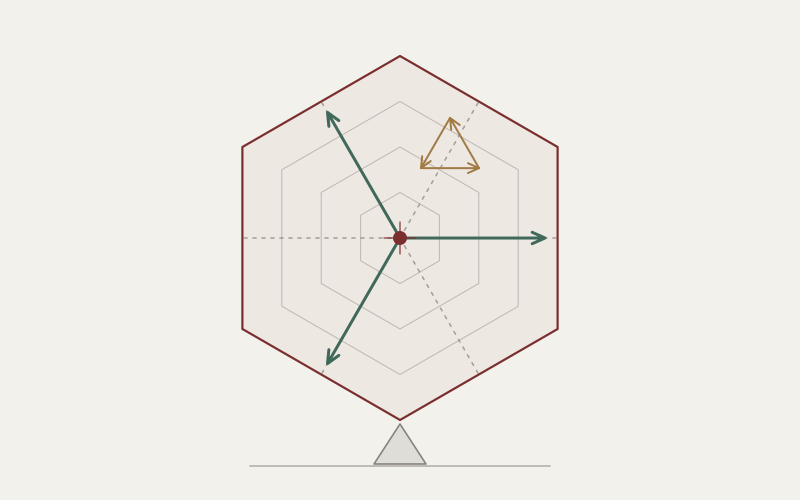
Archimedes proved that the centre of gravity of a triangle is the point where its medians meet. The proof sits in a treatise about levers, On the Equilibrium of Planes, and in twenty-two centuries the point has not moved. Since the work of Toshiki Mabuchi in 1987 and of Xu-Jia Wang and Xiaohua Zhu in 2004, the same kind of point, the centre of gravity of a polytope, decides one of the hard questions of complex geometry: whether a certain kind of space admits a Kähler–Einstein metric, the nearest thing it has to a perfect shape.
A nonlinear partial differential equation that reduces to a problem Archimedes could have posed is rare luck, and I want to show what the luck buys. Beside the Einstein metric lives a second and cheaper notion of balance, called stability. The two are easy to confuse and hard to separate. I built a family of spaces, indexed by arrows on a hexagon, in which they come apart as transparently as I know how to arrange: the arrows cancel, every part of the space is lighter than the whole, and the hexagon still leans.
I · Two kinds of balance.
Start with the expensive one. Einstein’s equation for empty space with a cosmological constant says that the Ricci curvature is a fixed multiple of the metric. Drop time, keep the equation, and ask for a complex manifold whose Kähler metric satisfies it with a positive constant. That is a Kähler–Einstein metric on a Fano manifold. The round sphere is the model: its curvature is the same at every point and in every direction, and nothing on it is privileged.
Not every Fano manifold has such a metric. Yozô Matsushima showed in 1957 that the holomorphic symmetries of a Kähler–Einstein Fano manifold must form a reductive group, and the projective plane blown up at one or two points fails that test. Those spaces have no best shape, only better and worse ones.
The cheap notion lives on vector bundles. A bundle attaches a vector space to every point of a space; the tangent bundle attaches the directions in which one can move. Every bundle has a slope, its degree divided by its rank, which you may read as curvature per direction. A bundle is stable when every proper subsheaf, every coherent sub-family of directions, has strictly smaller slope than the bundle itself. No faction is heavier per head than the whole. David Mumford introduced the idea for bundles on curves in the early 1960s, and Takemoto carried it to higher dimensions in 1972. The Latin is apt: stabilis is what is able to stand.
The two notions are joined by one of the great theorems of the 1980s. Simon Donaldson, and then Karen Uhlenbeck and Shing-Tung Yau, proved that a bundle admits a Hermitian–Einstein metric, the bundle’s own version of perfect balance, exactly when it is polystable: a direct sum of stable pieces of equal slope. A Kähler–Einstein metric on a manifold is in particular a Hermitian–Einstein metric on its tangent bundle, so the expensive condition buys the cheap one. Kähler–Einstein implies a polystable tangent bundle.
The converse fails, and it fails early. Rachid Fahlaoui showed in 1989 that the plane blown up at two points has a stable tangent bundle, although Matsushima forbids it an Einstein metric. In my census of smooth toric Fano varieties the gap widens with dimension. Of the 636 sixfolds whose tangent bundle is stable, 13 are Kähler–Einstein. Stability is common. Perfect balance is rare.
II · Statics instead of analysis.
Toric varieties are spaces with as many independent symmetries as they have dimensions, and all of their geometry is written into a polytope, the moment polytope, from which the space can be rebuilt. For a toric Fano variety the polytope is reflexive: every facet lies at lattice distance one from the origin.
Here the luck begins. Mabuchi showed that if a toric Fano variety carries a Kähler–Einstein metric, the barycentre of its moment polytope is the origin, and Wang and Zhu proved the converse. A fully nonlinear equation for a metric becomes a question about where a solid polytope balances. Barycentre is the right word; the Greek barys means heavy.
Stability turns into statics as well. Alexander Klyachko described equivariant bundles on toric varieties by filtrations of a single vector space, and for tangent bundles Milena Hering, Benjamin Nill and Hendrik Süß distilled from his description a clean test. Each facet of the polytope carries a weight, its volume, and belongs to an arrow in the lattice. For every proper subspace spanned by arrows, add the weights of the facets whose arrows lie in it and divide by the subspace’s dimension. The tangent bundle is stable when every such ratio is strictly smaller than the same ratio for the whole space.
Both conditions are therefore statements about one polytope, read in two ways. The Einstein metric asks where the solid balances. Stability asks how the weight of its surface is shared out among the directions. Because every facet sits at distance one, the facet weights add up to the volume of the whole, so the two readings concern the same total mass. One reading looks at its centre and the other at its distribution over subspaces, which is why the cheaper condition can hold while the expensive one fails.
III · A hexagon with twists.
The plane blown up at three points is a del Pezzo surface of degree six, and it is toric. Its six arrows are the roots of A2, the root system of SU(3): α, β, α+β and their negatives, which in suitable coordinates form a regular hexagon. Its moment polygon is also a hexagon, symmetric under a half-turn, so its barycentre is the centre and the surface is Kähler–Einstein. Its tangent bundle is stable.
The family began as a single line in a table. Among the 42 smooth toric Fano fivefolds of Picard number at least seven, exactly one has a stable tangent bundle, and its fan turned out to be this hexagon fibred over three projective lines. Each line twists the hexagon by a root, and the three roots are α, β and −(α+β). Once the pattern is visible, nothing stops you from choosing others.
So take k roots, repeats allowed, and fibre the hexagon surface over a product of k projective lines with those twists. The result is a smooth toric Fano variety of dimension n = k + 2 and Picard number n + 2, one new independent divisor class for every line. With every twist zero you get the plain product of the hexagon surface with k lines. Its tangent bundle splits into the hexagon’s directions and the lines’ directions, and each piece weighs exactly as much per direction as the whole. That is balance with ties: polystable, not stable. The twists break the ties.
The moment polytope of the twisted space is a prism over the hexagon. Above a point x of the hexagon it is a box whose i-th side has length 2 + ⟨x, ti⟩, a number between 1 and 3. Integrate the box away and the hexagon is left carrying a weight,
F(x) = (2 + ⟨x, t1⟩)(2 + ⟨x, t2⟩) ⋯ (2 + ⟨x, tk⟩),
and the polytope balances at the origin exactly when this weighted hexagon does. Each factor is heavier on the side its root points to, so every twist tilts the hexagon. The question of the Einstein metric is now whether a hexagon loaded by a product of tilts balances on a pin through its centre.
Try it. Each button adds a projective line twisted by that root. The left figure lays the twists tip to tail; the right one shades the hexagon by its weight and marks the balance point, with a lens that magnifies the centre when the point comes within a hair of it. The page also decides stability, by evaluating the Hering–Nill–Süß criterion in exact rational arithmetic, and it reproduces every entry in my paper’s two tables of root twists.
Experiment 01 · The weighted hexagon
Twist the hexagon.
Find its balance point.
Current twists. Press one to remove it.
n = 5 · Picard number 7
The twists sum to zero, so the zero-sum theorem gives stability. The multiset is symmetric under the 120° rotation, which pins the balance point to the centre.
Three twists (α, β, −(α+β)): a smooth toric Fano 5-fold of Picard number 7, with (−K)⁵ = 2,580. Its heaviest part has 98.1% of the whole’s slope, so the tangent bundle is stable. The balance point is exactly the centre, so the variety is Kähler–Einstein.
The calculation and its assumptions
Each button adds a factor ℙ1 twisted by the chosen root, or untwisted; the page allows ten. For twists t1, …, tk the variety has dimension n = k + 2 and Picard number n + 2. The shading shows F on the moment hexagon, drawn with the roots as unit vectors 60 degrees apart. The balance point is ∫xF / ∫F over the hexagon, computed as an exact fraction; by the paper’s prism lemma it vanishes exactly when the barycentre of the whole moment polytope does. The lens magnification is chosen so that the offset is visible.
Stability is Klyachko’s criterion in the form of Hering, Nill and Süß. A subspace spanned by rays meets the hexagon’s plane in zero, a root line or the whole plane, so the heaviest subsheaf is found by sorting a few exact degrees. Its slope is compared with μ(TX) = (n − 1)!∫F. “Tied” means semistable but not stable. An automated check confirms the paper’s tables, its zero-sum and Kähler–Einstein theorems for every zero-sum list of at most seven roots, and its reduction criterion for every list of at most six. The figure illustrates published criteria for this one family; it proves nothing beyond them.
IV · Balanced on average.
The first theorem is about the sum. If the twists are nonzero roots that add up to zero, the tangent bundle is stable. The pair α, −α qualifies, so does the rotation α, β, −(α+β), and so does any longer list whose arrows close up when laid tip to tail. Pairs add two dimensions at a time and a rotation adds three, so every dimension from four on is reached: the theorem gives stable tangent bundles of Picard number n + 2 in every dimension n ≥ 4.
The second theorem is about symmetry, and it is the reason for the title. Among these zero-sum lists, the space is Kähler–Einstein exactly when the list is unchanged by negating every root or by turning the hexagon through 120 degrees. Cancellation is not enough.
The reason fits in a paragraph. Write ℓi(x) = ⟨x, ti⟩ and expand the weight, F = 2k(1 + ℓ1/2)⋯(1 + ℓk/2): a constant, then the sum of the ℓi/2, then products of pairs, then of triples. The hexagon is symmetric under x ↦ −x, so terms of even degree pull the balance point nowhere. The first term that moves it is linear, and because a regular hexagon has the same moment of inertia about every axis through its centre, ∫ x ℓi(x) dx is a fixed multiple of ti. To first order the balance point moves in the direction of t1 + ⋯ + tk.
In words: a zero sum balances the hexagon to first order. The products of three twists come next, and nothing about a zero sum makes them cancel. A symmetry does. If the list is unchanged by negation, the weight is an even function and the hexagon balances by reflection through its centre. If it is unchanged by the rotation, the balance point is fixed by a 120-degree turn, and only the centre is. The hard direction, which the paper proves, is the converse: without one of the two symmetries the balance point always misses.
The smallest miss has five twists: α, α, β, −α, −(α+β). Laid tip to tail they close. The space is a sevenfold, and its tangent bundle is stable. Its balance point, computed exactly, is (−3/9632, 3/19264) in lattice coordinates, about three ten-thousandths of the way from the centre to an edge. Press Balanced, not Einstein and the lens shows it. Three ten-thousandths is a small distance and an absolute verdict. The criterion is an equation, not a tolerance.
On the stability side the sum enters through a different door. The directions along the hexagon form a subsheaf, and its slope minus the slope of the whole is a positive multiple of the integral over the hexagon of F times ∑ ℓi/(2 + ℓi). The function u ↦ u/(2 + u) is concave, so by Jensen’s inequality that sum is at most k times the same function of the average of the ℓi, and the average vanishes when the twists sum to zero. The hexagon’s directions come out strictly lighter than the whole. The remaining subsheaves need convolution estimates over boxes, but the principle survives them: stability is content with twists balanced on average, and the Einstein metric demands balance at every order.
Balance on average is sufficient for stability, not necessary. The pair α, β does not sum to zero, yet its fourfold has a stable tangent bundle; it is the first member of an unbalanced family in the paper, all stable and none Einstein. Lean too far and stability goes too. Two copies of one root, α, α, give a fourfold whose fibre directions outweigh the whole by six and a half per cent.
For the mathematician
Let R = {±α, ±β, ±(α+β)} in Nf ≅ ℤ2. For t1, …, tk ∈ {0} ∪ R the fan of X(t) in Nf ⊕ ℤk has rays the six roots, fi + ti and −fi; its maximal cones are spanned by two adjacent roots and one of the two lifts for each i. X(t) is a smooth toric Fano variety of dimension k + 2 and Picard number k + 4, and its anticanonical polytope is the prism {(x, y) : x ∈ Q, −1 − ⟨x, ti⟩ ≤ yi ≤ 1}, where Q = {⟨x, ρ⟩ ≥ −1 for all ρ ∈ R}. Then (−K)n = n!∫QF, μ(TX) = (n − 1)!∫QF, and the barycentre has fibre component ∫QxF / ∫QF and base components −½⟨bx, ti⟩.
Zero-sum stability and the Kähler–Einstein classification are Theorems 7.2 and 7.3 of the paper, the prism structure is its Lemma 7.4, and Proposition 7.6 reduces stability to one integral per twist and a strict triangle inequality among three line shares. The page reproduces (−K)n = 268, 278, 2580, 2880, 29928, 30960, 404544 and 6242544 for the paper’s nine tabulated twist lists, and the slopes 516 and 506 of the fivefold F.5D.0611.
V · Ties.
Between stable and unstable lies the tie, where some part weighs exactly as much per direction as the whole. Add an untwisted line in the experiment and you get one: the line splits off with exactly the whole’s slope, and the bundle is semistable without being stable. For toric tangent bundles the paper settles what a tie can mean. A strictly semistable tangent bundle is polystable, and so carries a Hermitian–Einstein metric, exactly when the variety is a product of smaller toric Fano varieties whose tangent bundles are stable. A tie that does not come from a product is fatal to the metric.
What a fatal tie looks like analytically is the subject of a companion paper. Hermitian Yang–Mills flow is a heat equation that moves a metric on a bundle toward balance. On a semistable bundle that is not polystable it never arrives, because there is nowhere to arrive, and along the flow the bundle comes to look more and more like the direct sum of its stable pieces. What can be measured along the way is the spectrum: the small eigenvalues of the Dolbeault Laplacian, which tend to zero as the bundle comes closer to splitting. For the bundles studied there, simple bundles on curves and extensions of one polystable bundle by another, in both cases with pairwise distinct stable pieces, each small eigenvalue is asymptotic to an eigenvalue of a weighted graph Laplacian. Its vertices are the stable pieces, an edge joins two pieces linked by a nonzero extension, and the conductances on the edges evolve by an explicit finite-dimensional flow. A failure to balance has the structure of an electrical network.
VI · Beyond one hexagon.
A single hexagon fixes the Picard number at n + 2. Stack several hexagon surfaces over products of projective spaces, with arbitrary integral twists, and the second paper shows that within this class of bundles the largest Picard number compatible with a stable tangent bundle in dimension n ≥ 4 is ⌊5n/4⌋ + 1. That equals n + 2 through dimension seven and overtakes it from dimension eight on. The existence proofs rest partly on finite exact rational calculations with uniform error estimates, printed in the paper and reproduced by its code. The same paper treats blowups of products of projective spaces arranged along a tree, where stability reduces to one inequality at each vertex: trees in which no vertex meets more than three edges give stable examples when every vertex that is not a leaf has dimension equal to its number of edges, and a specified arrangement around a vertex of degree four forces instability. Whether a smooth toric Fano variety outside these constructions beats ⌊5n/4⌋ + 1 is open.
Coda · First order.
In my other room this distinction has a name. A portfolio whose market betas sum to zero is neutral to first order, and the first order is all that a calm market asks about. The quantitative long–short funds that lost heavily in August 2007 were, by construction, neutral to the market. What they shared was a later term in the expansion: a crowd of similar positions, unwound at once. A zero sum is a statement about the average. Risk lives in the terms that the average does not see.
Geometry is kinder than the market in one respect. It tells you exactly which symmetries make the higher terms vanish, and it proves that nothing else will. Archimedes, in a saying that Pappus attributes to him, asked only for a place to stand. A stable bundle has one. An Einstein metric asks for more: that the weight fall exactly where it stands.