Research / Knots, four-manifolds & Floer theory
What survives when we cut a space apart?
Cut a space apart and a geometric question becomes a comparison between algebraic objects, one for each piece. The art lies in keeping the information needed to glue the pieces back together, which is exactly what the pieces, examined one at a time, forget.
A route through the subject
Knots, four-manifolds & Floer theory
01
Knots
Compare instanton invariants with immersed curves in the pillowcase.
02
Cobordisms
Ask how comparisons behave when the spaces themselves change.
03
Four-manifolds
Separate the structure of a construction from its unresolved filling question.
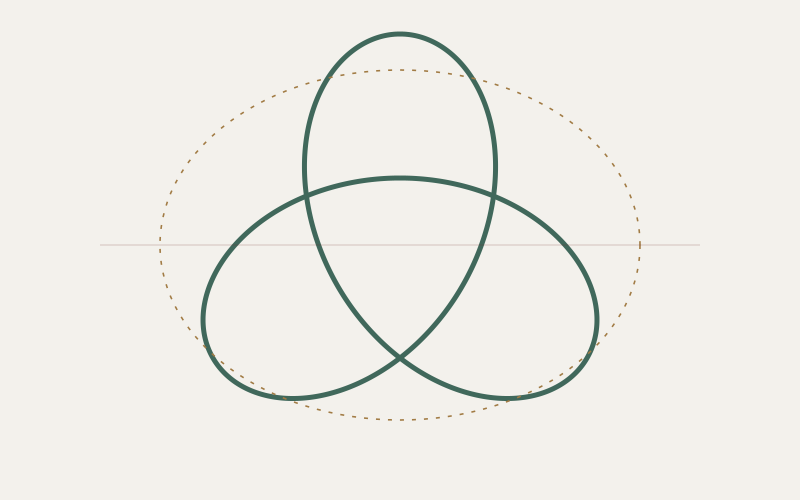
Start with a trefoil
Then continue to the manuscripts below. The illustrations offer intuition; each paper states the mathematical or empirical scope of its argument.
A manuscript to begin with: Traceless SU(2) characters and ℤ/4 instanton gradings for two-bridge and (3,n)-torus knots.
Scope of the work
These manuscripts do not share a proof status, and the differences matter. The Maurer–Cartan paper makes comparisons that are conditional on a conjecture. The exotic four-manifold manuscript, a working revision, withdraws an earlier claim and leaves its final filling question open. Each paper’s page states its own qualifications.
10 papers · Suggested reading sequence
The manuscripts.
- 01
Traceless SU(2) characters and ℤ/4 instanton gradings for two-bridge and (3,n)-torus knots
The instanton side: generators, gradings, and differential ranks for torus and two-bridge knots, with results credited to their sources.
Preprint · 2026 · Abstract, PDF & citation ↗
Read the abstract
For every torus knot, the rank of the differential of the Daemi–Scaduto S-complex of singular instanton homology is determined by the signature and the Alexander polynomial; this follows from theorems of Li–Ye and Daemi–Scaduto. For the torus knots the differential has rank zero or one according to modulo , and its rank equals Daemi and Scaduto’s Frøyshov-type invariant; they proved this in two of the four residue classes and for , and Hedden, Herald and Kirk computed it for . Following Lewallen, Klassen and Hedden–Herald–Kirk, we describe the generators of the instanton complexes and their gradings for two-bridge knots, whose irreducible traceless characters are all binary dihedral, and for , where at most one is. We also give a proof through Khovanov homology, using Schütz’s computation for three-braids, of Li and Ye’s computation of the rank of the instanton homology of , and compare the differential of the knot with the single pillowcase bigon of Hedden, Herald and Kirk.
- 02
The S-complex differential of torus knots
The torus-knot differential: floor-sum formulas, rank bounds, and a classification of when it vanishes.
Preprint · 2026 · Abstract, PDF & citation ↗
Read the abstract
For a torus knot the traceless character variety is finite and nondegenerate, so Daemi and Scaduto’s S-complex for singular instanton homology can be built on it. The resulting complex has rank , where is the signature, and by theorems of Li and Ye and of Kronheimer and Mrowka its homology has rank , the sum of the absolute values of the coefficients of the Alexander polynomial; so the differential has rank . We express through floor sums and show that, for coprime , , where is the inverse of modulo , and that the differential vanishes if and only if , or is odd and or ; the ‘if’ direction is due to Daemi and Scaduto. By a result of Daemi and Scaduto, the component of the differential to the reducible generator is nonzero over exactly when their invariant is positive. We show that the components from degree to degree and from degree to degree have ranks and , independently of the choices in the construction. In particular the -graded group depends only on and , and we give it explicitly. In each small-perturbation pillowcase computation of Hedden, Herald and Kirk, a bigon ends at the reducible generator exactly when . We formulate a chain-level conjecture identifying the two complexes over ; it predicts this pattern whenever the map to the reducible is nonzero modulo .
- 03
Pillowcase Floer homology of the torus knots T(3,n)
The pillowcase side: a graded computation for the T(3,n) family and comparison with instanton homology.
Preprint · 2026 · Abstract, PDF & citation ↗
Read the abstract
Hedden, Herald and Kirk defined a Lagrangian Floer homology in the pillowcase from a tangle decomposition of a knot and conjectured that, for a suitable decomposition, it recovers reduced singular instanton homology. We compute this homology for every torus knot , using their decomposition. For all sufficiently small holonomy perturbations in an explicit closed cone, the immersed curves are restricted and the complex has generators, where is the signature. There is no differential when and exactly one, to the generator of the abelian representation, when . The -graded homology has the graded dimensions of reduced instanton homology. This verifies the conjecture of Hedden, Herald and Kirk for this infinite family, and, combined with a cobordism inequality of Daemi and Scaduto, shows that over the pillowcase complex is S-chain homotopy equivalent to their singular instanton S-complex. The proof rests on an explicit description of the traceless character variety and the strict monotonicity of an angle function along its components; three inequalities are verified by interval arithmetic. For a different decomposition of in the same family, a numerical computation gives homology of rank rather than with zero bounding cochain.
- 04
Instanton and pillowcase homology of the (−2,3,q) pretzel knots
A suitable tangle decomposition of hyperbolic P(−2,3,q) pretzel knots and the resulting Floer comparison.
Preprint · 2026 · Abstract, PDF & citation ↗
Read the abstract
Hedden, Herald and Kirk conjectured that every knot admits a decomposition along a Conway sphere for which the Lagrangian Floer homology of the two associated immersed curves in the pillowcase recovers Kronheimer and Mrowka’s reduced singular instanton homology. We prove the conjecture for the hyperbolic pretzel knots ; it was previously known for two-bridge knots and for some torus knots. The decomposition is obtained from Hedden, Herald and Kirk’s decomposition of the torus knot by Dehn twists along the Conway sphere, which act on the pillowcase by a linear shear. Building on our analysis of the torus knots , we compute the Floer complex and its grading by hand; its differential is nonzero for every member of the family except . The same method proves the conjecture for a family of twisted torus knots, under a hypothesis on the chirality of the torus-knot decomposition. On the instanton side, we show that the instanton homology of is free abelian of rank for every odd , extending Lobb and Zentner’s rational computation to the integers by means of Manion’s integral Khovanov homology; for the hyperbolic members this also follows from work of Daemi and Scaduto.
- 05
Maurer–Cartan elements in the pillowcase and the Bar-Natan invariant for the (−2,3,q) pretzel knots
A different decomposition needs bounding cochains; explicit algebraic deformations lead to conditional comparisons.
Preprint · 2026 · Abstract, PDF & citation ↗
Read the abstract
Cazassus, Herald, Kirk and Kotelskiy conjectured that the reduced singular instanton homology of a knot is recovered from any decomposition along a Conway sphere by Lagrangian Floer homology in the pillowcase, once the immersed curves of the two tangles carry suitable bounding cochains. For Smith’s decomposition of the pretzel knots , which separates a rational tangle carrying the earring from the sum of two other rational tangles, zero bounding cochains give the wrong rank. Working in the algebraic model of Kotelskiy, Watson and Zibrowius, where the Maurer–Cartan equation is a finite identity, we construct for and explicit Maurer–Cartan elements, each obtained by smoothing a model of Smith’s curve at a single self-intersection, that restore the rank. For , a second closure of the tangle selects one of them, conditionally on the conjecture and on a hypothesis about the support of the cochain. The resulting object is a rational arc together with a closed curve carrying a two-dimensional local system, and one further term near a corner turns it into the Bar-Natan invariant of the tangle. Granting one case of an intersection formula of Kotelskiy, Watson and Zibrowius, we show that no rational closure distinguishes the two. We ask whether the object that the conjecture assigns to this tangle is its Bar-Natan invariant, and record evidence on both sides.
- 06
Point operations and matching-line bubbles in the Atiyah–Floer comparison
Point operations in the Atiyah–Floer comparison, including genus-dependent correction terms.
Preprint · 2026 · Abstract, PDF & citation ↗
Read the abstract
We prove compatibility of the integral point operations in the admissible Atiyah–Floer comparison of Daemi, Fukaya, and Lipyanskiy, in their embedded-Lagrangian setting. In the positive normalization, the symplectic point operation is shifted by , , or according as the marked component has genus one, two, or at least three. One coherent orientation system works for both matching components. Together with the known surface and loop comparisons and integral operation relations, this gives the corrected observable-algebra action over every commutative coefficient ring. When four is invertible, quarter-Pontryagin normalization gives the shifts , , and .
An index-four mixed sequence can develop a matching bubble of normalized energy one-half. Holomorphic doubling and the converse estimates identify compact limiting models: degree-one stable families and single elementary modifications of constant families. A Dirichlet construction reconstructs these models and glues them to regular index-zero mixed solutions. Converse gluing and the incidence conditions identify every bubbling end of the chosen point cut. The relative incidence degrees are eight and four in genera one and two. Comparing the actual gluing derivative with determinant-line excision determines their signs. Ordinary reference orientations agree for the two homologous matching surfaces; a local sphere comparison and a stabilized torus example fix the genus-two normalization even when the ambient rational Floer homology vanishes. The resulting boundary identity uses the original integral geometric count as its homotopy.
- 07
Cobordism maps and Atiyah–Floer isomorphisms for framed instanton homology I
Compatibility with four-dimensional cobordism maps over the field of two elements.
Preprint · 2026 · Abstract, PDF & citation ↗
Read the abstract
We prove that isomorphisms of the type constructed by Daemi, Fukaya and Lipyanskiy, between framed instanton homology and the Lagrangian Floer homology of a Heegaard splitting, intertwine the cobordism maps of Kronheimer and Mrowka with maps defined by holomorphic curves alone, over the field of two elements. This holds for every connected cobordism between connected three-manifolds carrying a framed arc between its ends and an bundle trivialized along the ends and the arc. The symplectic maps count holomorphic triangles in moduli spaces of flat connections on surfaces, with the correspondence of a compression body as boundary condition for one- and three-handles. Consequently these maps are independent of the handle decomposition and of the Heegaard data, and form a functor isomorphic to framed instanton homology; where both are defined, our isomorphisms agree with those of Daemi, Fukaya and Lipyanskiy modulo two. The proof rests on two analytic results for the mixed anti-self-duality and holomorphic curve equation: an adiabatic limit in which a compression body collapses next to a holomorphic strip and becomes the Lagrangian boundary condition of its flat connections, and an excision theorem along a torus.
- 08
Cobordism maps and Atiyah–Floer isomorphisms for framed instanton homology II
The integral comparison: orientations, signed counts, and the remaining overall sign for each cobordism.
Preprint · 2026 · Abstract, PDF & citation ↗
Read the abstract
We prove that the mixed isomorphisms of Daemi, Fukaya and Lipyanskiy type between framed instanton homology and the Lagrangian Floer homology of a Heegaard splitting intertwine the integral instanton cobordism maps, oriented by almost-complex structures, with signed symplectic cobordism maps, up to chain homotopy and one overall sign for each cobordism. This holds for every connected cobordism between connected three-manifolds carrying a framed arc and an bundle trivialized along the ends and the arc. Where the integral framed instanton homology is nonzero, the symplectic maps are signed counts of holomorphic triangles, with the Lagrangian correspondence of a compression body as one boundary condition for one- and three-handles. At three-manifolds whose integral framed instanton homology vanishes, the complexes are contractible and the maps are zero. The orientations are transported from the gauge theory through the mixed anti-self-duality and holomorphic curve equation. Consequently these maps form a projective functor on homology, independent of the handle decomposition up to sign. The unsigned analysis is that of the comparison modulo two; the new input is that two degenerations of the mixed equation, the collapse of a compression body and excision along a torus, preserve orientations. Where this homology is nonzero, we also prove that the sign by which the orientations change when a sphere is attached to a strip is constant under small perturbations and invariant under reversing the splitting. The relation with homology-oriented integral instanton maps is left open.
- 09
One-bubble neighborhoods in SO(3)-monopole moduli spaces
An oriented neighborhood model at the first Uhlenbeck level of SO(3)-monopole moduli spaces under regularity hypotheses.
Preprint · 2026 · Abstract, PDF & citation ↗
Read the abstract
We prove an oriented neighborhood theorem at the first Uhlenbeck level of -monopole moduli spaces, over a compact regular Seiberg–Witten moduli space of arbitrary dimension whose solutions have nonzero spinor. A finite-dimensional obstruction model admits an equivariant compactified embedding that maps the obstruction zero set homeomorphically onto an Uhlenbeck-open neighborhood of the ideal stratum; its restriction to that zero set at positive scale is a diffeomorphism onto its image. The principal analytic step is a strong approximation theorem in critical norms for arbitrary convergent one-bubble monopole sequences. Uniform gauge estimates and summable decay along the neck recover the gluing parameters, including the relative frame, and give reverse uniqueness. A global equivariant stabilization treats the background family without requiring a constant-rank spectral cutoff. Comparison with Donaldson’s instanton-addition map identifies the induced orientation with the standard monopole orientation. Under the additional topological hypotheses of Feehan and Leness, the construction supplies the analytic neighborhood input to their level-one link pairing. We state the resulting polynomial formula and its low-degree consequences for Witten’s conjecture on abundant, effective manifolds of Seiberg–Witten simple type.
- 10
Toward an exotic S²×S² and an exotic ℂP²#ℂP̄²
A working revision deriving the full group presentation; the final filling question remains open.
Working revision · 2026 · Abstract, PDF & citation ↗
Read the abstract
We study a specified Luttinger filling in the construction of Lidman and Piccirillo whose simple connectivity would yield exotic and . An earlier version of this manuscript claimed simple connectivity from incorrectly derived group relations; that claim is withdrawn. We derive the complete fundamental-group presentation and express the group as a one-relator quotient of an iterated HNN extension containing the genus-two surface group. The filled group is trivial exactly when the final relation kills a specified fiber commutator. We also determine its universal central extension with cyclic kernel, construct geometric realizations of it, and extend the boundary involution over the filling. Proposed symplectic extensions construct a torus with a negative area–Maslov relation and exact tori detecting a nonzero transfer kernel for a choice of auxiliary handles. These constructions do not establish survival of the central element. The final filling problem remains unresolved.